

Reception: +91-830 290 2727
Office: +91-830 290 2727
E-mail: kaladwaslalhaveli@gmail.com
Address: 96, Chawra House Ganesh Ghati Udaipur, Rajasthan 313001
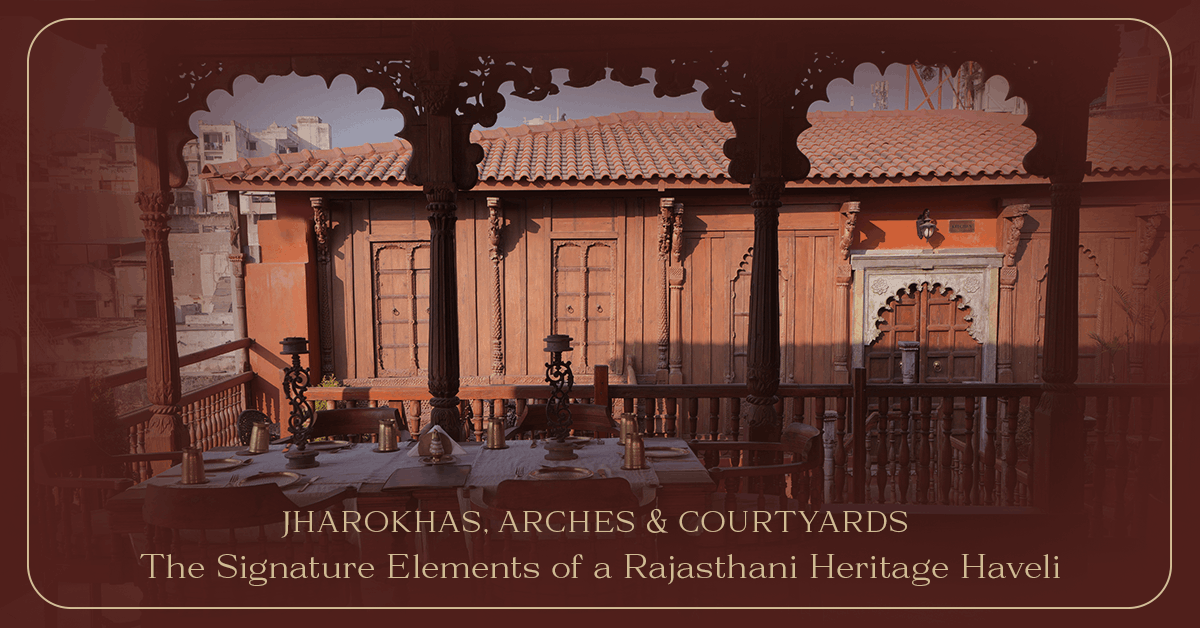
Jharokhas, Arches & Courtyards: The Signature Elements of a Rajasthani Heritage Haveli
A historic haveli rarely reveals its character all at once. You notice it gradually: the shape of an arch, the shadow beneath a balcony, the way daylight enters a courtyard, or the craftsmanship around an old doorway.
These details are easy to photograph, but they are more interesting when you understand what they were designed to do.
In Rajasthan, architecture developed in response to climate, privacy, social customs, craftsmanship and the way families used their homes. Jharokhas, arches and courtyards were therefore not simply decorative features. They helped shape how people saw, moved through and experienced a traditional residence.
This is part of what makes a Rajasthani heritage haveli so compelling today. Its architecture can be read almost like a record of everyday life.
At Kaladwas Lal Haveli in Udaipur, these architectural traditions remain part of the identity of a 300-year-old restored haveli that has been adapted into a boutique hotel. The property describes its restoration as an effort to preserve original architectural elements while making the historic residence suitable for contemporary hospitality.
What Defines a Rajasthani Heritage Haveli?
A haveli is more than an old house with elaborate decoration. Traditionally, it was a carefully organised residence in which architecture, privacy, climate and social life were closely connected.
The exact appearance of a haveli varied according to its region, period, wealth and purpose. Yet certain elements appear repeatedly in the architectural vocabulary of Rajasthan.
Among the most recognisable are:
- Jharokhas — projecting or overhanging windows and balconies associated with traditional Rajasthani architecture.
- Arches — structural and visual elements that create transitions between rooms and spaces.
- Courtyards — open spaces around which domestic life could be organised.
- Carved doors and columns — details that demonstrate the skill of local craftsmanship.
- Decorative surfaces and traditional finishes — elements that give each property its individual visual identity.
Together, these features create the layered character associated with a traditional haveli.
The important point is that their beauty comes from purpose as much as ornament.
Jharokhas: Windows That Frame More Than a View
Few architectural details are as strongly associated with Rajasthan as the jharokha.
A jharokha is a projecting window or enclosed balcony, often elaborately carved and positioned on the exterior of a building. Historically, such spaces could provide occupants with a way to look out onto streets and surroundings while maintaining a degree of privacy.
That combination of observation and separation gave the jharokha both a practical and architectural role.
Today, travellers often notice the craftsmanship first. A carved frame catches the light differently throughout the day. Shadows deepen the patterns. From inside, the opening creates a carefully framed view rather than an uninterrupted one.
This is an important distinction.
Traditional architecture often controlled the relationship between interior and exterior instead of simply opening one completely to the other.
At Kaladwas Lal Haveli, the property’s own heritage material identifies carved jharokhas among the architectural elements preserved as part of the restoration.
For a guest, noticing a jharokha is therefore not merely noticing decoration. It is seeing one of the architectural devices through which an older residence connected private life with the world outside.
Arches: Creating Rhythm Through Architecture
Walk through a historic haveli and arches often appear almost naturally in the sequence of spaces.
An arch can mark a doorway, divide two areas or create a visual transition without making the architecture feel heavy. Repeated arches can also establish rhythm: one opening leads to another, creating depth and making even a relatively compact space feel layered.
In heritage architecture, this matters because movement through the building becomes part of the experience.
You do not necessarily see the entire space from the beginning.
Instead, architecture reveals it in stages.
At Kaladwas Lal Haveli, arches are specifically referenced as part of the restored architectural character of the 300-year-old property. The hotel’s heritage pages describe the restoration as preserving elements including arches, courtyards, carved details and other traditional features.
The effect is subtle. An arch does not need to announce itself. Its success is often in how naturally it guides the eye from one space to another.
Courtyards: The Social Heart of a Haveli
If jharokhas connect a home with the outside world, courtyards can be understood as spaces that organise life within it.
The courtyard is one of the defining features of traditional haveli architecture. An open area enclosed or surrounded by rooms allows light and air to enter the building while creating a central space around which domestic activity can take place.
But a courtyard is also atmospheric.
During the day, sunlight changes its appearance. At different times, shadows move across walls and floors. In the evening, the open sky changes the mood completely.
This changing quality is one reason courtyards remain so appealing in contemporary heritage hospitality.
They are not static interiors.
They respond to the time of day.
Kaladwas Lal Haveli’s official heritage material highlights its courtyards as part of the property’s restored architectural character, while its gallery describes peaceful courtyards as among the visual features of the heritage property.
For guests, a courtyard can become a place to pause between exploring Udaipur and returning to the rhythm of the hotel.
Why These Elements Matter Beyond Aesthetics
It is tempting to view heritage architecture through photography alone.
Jharokhas look beautiful in photographs. Arches create dramatic compositions. Courtyards are naturally suited to atmospheric images.
But reducing these elements to visual appeal misses much of their value.
Traditional architecture often reflects the practical realities of the place where it developed.
Climate matters. Privacy matters. The availability of materials matters. Social structures matter. Craft traditions matter.
Architecture is the result of these things coming together.
That is why looking closely at a haveli can tell you something about the culture that produced it.
A carved detail is evidence of craftsmanship. A courtyard reveals an approach to organising space. A jharokha reflects a particular relationship between privacy and the street. An arch can reveal how spaces were connected and structured.
The building becomes a cultural document.
Reading Udaipur Through Its Havelis
Udaipur is often introduced through its lakes, palaces and grand landmarks. Those places deserve their attention, but the city’s architectural identity is also found at a smaller scale.
Historic neighbourhoods reveal another side of the city.
Here, architecture is encountered through doorways, balconies, courtyards, narrow streets and details that are easy to overlook if you move too quickly.
This is where a heritage stay in Udaipur can change the way a traveller experiences the destination.
Instead of seeing traditional architecture only as something to visit, you wake up surrounded by it.
Kaladwas Lal Haveli is located in Udaipur’s Old City, and its heritage pages position the property within the historic character of the city. The hotel is also close to several of Udaipur’s well-known heritage attractions, including Jagdish Temple, Gangaur Ghat, Lake Pichola and Bagore Ki Haveli.
The advantage is not simply convenience.
It creates continuity between the places you explore outside and the architecture you return to afterwards.
The Craftsmanship Behind the Details
Architecture tells only part of the story. Craftsmanship completes it.
Traditional havelis depend on the hands of artisans as much as on architectural planning. Carved wood, decorative surfaces, traditional plastering techniques and carefully restored details all contribute to the personality of a historic building.
This is particularly important during restoration.
The goal is not necessarily to make an old property look new. A sensitive restoration seeks to retain the qualities that make the building historically distinctive while ensuring that it remains functional and safe.
Kaladwas Lal Haveli describes its restoration as involving structural reinforcement alongside the preservation and restoration of original elements. Its heritage material also notes traditional plastering work carried out by artisans skilled in the technique.
That balance is what allows heritage architecture to remain part of contemporary life.
A building survives not simply because it is old, but because it can continue to have meaning.
From Historic Residence to Boutique Hotel
Turning a historic haveli into a boutique hotel creates an interesting relationship between preservation and hospitality.
A hotel has to provide comfort, privacy and practical facilities for today’s traveller. A heritage property, meanwhile, has a physical identity that should not be erased in the process.
The strongest heritage hotels work within that tension.
At Kaladwas Lal Haveli, the transformation from a 300-year-old haveli into a boutique hotel has involved preserving the property’s architectural character while incorporating modern comforts. The hotel’s seven individually themed rooms are also designed around different aspects of Rajasthan and Mewar’s cultural heritage.
This makes the architecture more than a backdrop.
It becomes part of the stay.
A guest might notice a carved detail in the morning, pass through an arch on the way to another space, spend time in a courtyard later in the day and return to a room whose design continues the heritage theme.
The experience is cumulative.
How to Appreciate a Heritage Haveli as a Traveller
You do not need to be an architect to appreciate traditional architecture.
A little curiosity is enough.
When staying in a heritage property, look for:
1. The way light moves through the building.
Notice how courtyards, openings and windows change the atmosphere during the day.
2. The craftsmanship.
Look closely at carved wood, decorative surfaces, doors and other details. The closer you look, the more you tend to notice.
3. The relationship between public and private spaces.
Consider how entrances, corridors, arches and balconies control movement and visibility.
4. Signs of restoration.
A preserved building is not necessarily untouched. Look for the distinction between historic elements and carefully integrated contemporary additions.
5. The relationship with the neighbourhood.
A heritage haveli makes more sense when viewed as part of the historic city around it.
This approach turns an architectural stay into a form of cultural exploration.
Why Jharokhas, Arches and Courtyards Still Matter
The enduring appeal of these elements is not simply nostalgia.
They continue to matter because they demonstrate how architecture can combine usefulness, craftsmanship and beauty without separating the three.
A jharokha is a window, but also a carefully designed relationship between inside and outside.
An arch is a structural or spatial transition, but also a way of creating rhythm.
A courtyard is an open space, but also a place where light, air and human activity meet.
That is what makes traditional architecture worth preserving.
It gives modern travellers something that newly constructed spaces often struggle to reproduce: a visible connection between design and history.
Experiencing the Language of the Haveli at Kaladwas Lal Haveli
At Kaladwas Lal Haveli, the architectural vocabulary of the traditional haveli remains central to the property’s identity.
The hotel presents itself as a 300-year-old restored heritage haveli in Udaipur’s Old City, with traditional Rajasthani architecture, restored details, individually designed rooms and a strong connection to Mewari heritage.
Its seven themed rooms extend that idea into the guest experience. Rather than treating every room as interchangeable accommodation, the property gives each one a distinct identity inspired by different aspects of Rajasthan and Mewar.
For travellers who choose a boutique hotel in Udaipur because they want a stronger sense of place, this distinction matters.
The architecture is not something you simply look at during a sightseeing visit.
It surrounds you.
And that can make the history of a city feel considerably more immediate.
Conclusion: When Architecture Becomes Part of the Stay
The beauty of a Rajasthani haveli is rarely found in one grand feature.
It lies in the relationship between many smaller ones: a jharokha framing a view, an arch leading into another space, a courtyard opening towards the sky, a carved doorway bearing the marks of skilled craftsmanship.
Together, these details create an architectural language.
In Udaipur, that language remains part of the city’s identity. Staying in a restored heritage property offers travellers the chance to encounter it not only as something to photograph, but as something to live around for a few days.
At Kaladwas Lal Haveli, the preservation of a 300-year-old haveli and its traditional architectural character forms the foundation of the boutique hotel experience.
And perhaps that is the most meaningful way to understand heritage architecture: not as something frozen in the past, but as a living environment that can still shape how people experience a place today.
FAQs
What are the main architectural features of a Rajasthani haveli?
Commonly recognised features include jharokhas, courtyards, arches, carved doorways, columns and decorative craftsmanship. Their exact design varies by region and period, but together they create the layered architectural character associated with traditional havelis.
What is a jharokha in Rajasthani architecture?
A jharokha is a projecting or overhanging window or balcony associated with traditional Rajasthani architecture. Besides its visual appeal, it could provide occupants with a way to observe the surroundings while maintaining privacy.
Why are courtyards important in traditional havelis?
Courtyards can bring light and air into a building while providing a central space around which different parts of the residence are organised. They also create an important social and atmospheric element within traditional haveli architecture.
What makes Kaladwas Lal Haveli a heritage boutique hotel in Udaipur?
Kaladwas Lal Haveli is a 300-year-old restored haveli in Udaipur’s Old City. Its heritage identity is reflected through traditional Rajasthani architectural elements, restored spaces and seven individually themed rooms inspired by aspects of Rajasthan and Mewar.
Can travellers experience traditional architecture while staying at a modern boutique hotel?
Yes. A thoughtfully restored heritage hotel can preserve historic architectural elements while adapting the property for contemporary hospitality. Kaladwas Lal Haveli describes its restoration as combining preservation of the haveli’s character with modern comfort.