

Reception: +91-830 290 2727
Office: +91-830 290 2727
E-mail: kaladwaslalhaveli@gmail.com
Address: 96, Chawra House Ganesh Ghati Udaipur, Rajasthan 313001
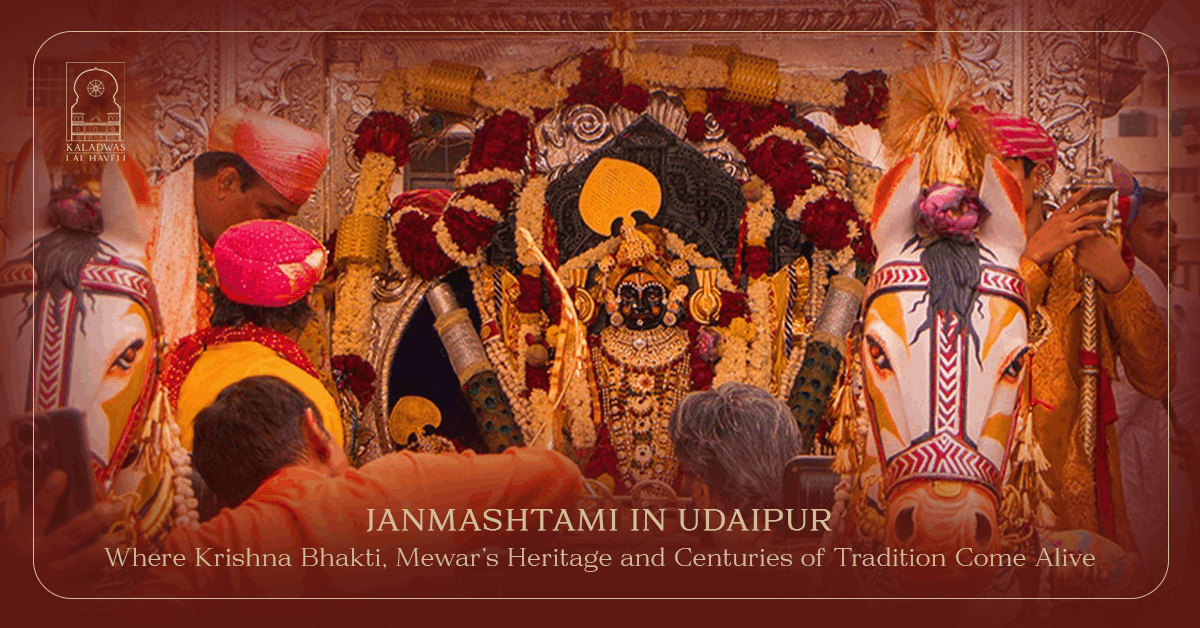
Janmashtami in Udaipur: Where Krishna Bhakti, Mewar’s Heritage and Centuries of Tradition Come Alive
There are festivals that are celebrated, and then there are traditions that become inseparable from the identity of a place.
Janmashtami in Udaipur belongs to the latter.
In the historic capital of Mewar, the celebration of Lord Krishna’s birth is woven into centuries of Vaishnav devotion, temple traditions, art, music and community life. From the historic Jagdish Temple in Udaipur’s old city to the sacred Shrinathji tradition of nearby Nathdwara, Krishna bhakti has left an enduring imprint on the cultural landscape of Mewar.
To experience Janmashtami in Udaipur is therefore to witness much more than a festival. It is to see a living heritage continuing through temples, paintings, music, food, flowers and generations of devotion.
A Centuries-Old Connection Between Udaipur and Krishna Bhakti
Mewar’s relationship with Krishna devotion can be traced through its temples, royal patronage and remarkable artistic traditions.
By the 17th century, Krishna was already an important subject of devotional imagination and artistic patronage across Rajasthan. The Metropolitan Museum of Art notes that Krishna and the stories surrounding his life became central to the religious imagination of patrons and artists in the region. Mewar’s own painting tradition also depicted Krishna narratives; works associated with Udaipur artists demonstrate the importance of Krishna themes in the courtly and devotional culture of the period.
This connection between devotion and artistic expression would become one of the defining characteristics of Krishna worship around Udaipur.
Here, faith was not simply spoken.
It was painted, sung, adorned and experienced.
Jagdish Temple: At the Heart of Janmashtami in Udaipur
Few places embody Udaipur’s historic religious character quite like Jagdish Temple.
Located in the heart of the old city, close to the City Palace, the temple belongs to the reign of Maharana Jagat Singh I, who ruled Mewar from 1628 to 1652. The temple was completed in the 17th century and became one of Udaipur’s most prominent Vaishnav landmarks.
Its towering architecture and position within the historic city make Jagdish Temple more than a religious monument. It remains part of Udaipur’s living cultural landscape.
During Janmashtami, that relationship becomes especially visible.
The temple precinct and surrounding lanes become spaces of devotion as worshippers gather for prayers and celebrations associated with Krishna’s birth. Bhajans, ceremonial adornment and temple rituals create an atmosphere that connects contemporary Udaipur with traditions carried through generations.
For travellers, this is perhaps one of the most meaningful ways to understand Janmashtami celebrations in Udaipur: not as a spectacle created for visitors, but as an enduring tradition belonging to the city itself.
Nathdwara and the Shrinathji Tradition of Mewar
To understand Krishna devotion in Mewar more deeply, one must also look beyond Udaipur towards Nathdwara, north of the city.
Nathdwara is home to Shrinathji, the celebrated manifestation of Krishna shown as a seven-year-old child lifting Mount Govardhan. The Metropolitan Museum of Art identifies Nathdwara as the centre of one of Rajasthan’s most important Shrinathji devotional traditions.
The Shrinathji image was brought to this region in the 17th century. According to the historical tradition recorded by The Met, those transporting the sacred image intended to continue towards Udaipur, but when the cart stopped at Nathdwara and would move no further, this was interpreted as divine will. The deity consequently found his home there.
Over time, Nathdwara developed into an important centre of pilgrimage, devotion and artistic production.
Its influence reached far beyond the temple walls, shaping the visual and cultural language of Mewar itself.
Pichwai: When Art Becomes an Act of Devotion
Perhaps no artistic tradition illustrates this relationship between Krishna and Mewar more beautifully than Pichwai painting.
Pichwais are elaborate painted textiles traditionally placed behind the image of Krishna in a shrine. They became particularly associated with the worship of Shrinathji at Nathdwara. The works depict Krishna’s stories, festivals and pastoral world through rich colours, flowers, cows, lotuses and intricate ornamentation.
Importantly, these paintings were not conceived merely as decoration.
They belonged to worship.
Different Pichwais could correspond with particular festivals and moments in the devotional calendar. The Met documents how large painted cloths were hung behind the principal image of Shrinathji according to the festival being observed.
It is this ability to transform faith into beauty that gives Krishna devotion in Mewar such a distinctive character.
The temple becomes a canvas.
The painting becomes prayer.
The celebration becomes art.
How Janmashtami Comes Alive in Mewar
Janmashtami in Mewar carries a sense of ceremony shaped by this wider devotional heritage.
Krishna is welcomed not simply through prayer, but through an entire sensory language of celebration – bhajans, festive shringar, flowers, temple offerings, devotional imagery and food.
The imagery associated with Shrinathji itself reflects this richness. Historical depictions preserved by The Met show the deity dressed in elaborate clothing and jewellery, demonstrating how adornment became deeply embedded within the devotional tradition.
That is what makes the festival particularly evocative here.
Faith moves effortlessly into craftsmanship. Ritual finds expression through colour and ornamentation. Music fills temple spaces. Food becomes an offering. Flowers become part of worship.
And centuries-old stories of Krishna are experienced once again by another generation.
Krishna Beyond the Temples: A Cultural Legacy
The influence of Krishna devotion in Mewar historically extended into the region’s royal and artistic worlds as well.
One remarkable painting dated 1767 depicts Maharana Ari Singh and his courtiers at Jagniwas Water Palace in Udaipur while a Rasa Lila — Krishna dancing with the gopis — is performed in the courtyard. The work provides a fascinating visual record of Krishna narratives being represented within the cultural world of the Mewar court.
This is an important dimension of Udaipur’s heritage.
Krishna was not present only within the sanctum of a temple. His stories found expression in painting, performance, poetry and royal patronage.
That legacy remains visible today in Mewar’s miniature paintings, Pichwai traditions, temples and continuing festivals.
Experiencing Janmashtami in Udaipur’s Old City
For travellers visiting Udaipur during Janmashtami, the old city offers an especially intimate perspective.
Around Jagdish Temple and the historic quarters surrounding the City Palace, Udaipur’s architectural heritage and living traditions exist side by side.
Walk through these lanes during the festive period and the city reveals something that monuments alone cannot convey.
You are not simply looking at history.
You are walking through a city where centuries-old traditions continue to have a place in everyday life.
And this is perhaps why staying within Udaipur’s historic quarters offers such a different experience from staying on its outskirts.
Stay Where Udaipur’s Heritage Still Lives
At Kaladwas Lal Haveli, our connection to Udaipur goes beyond proximity.
A 300-year-old living heritage haveli with seven uniquely themed rooms, Kaladwas offers travellers an opportunity to experience Mewar through the stories, architecture, craftsmanship, cuisine and traditions that have shaped this region for generations.
During Janmashtami, when the old city resonates with devotion and centuries-old traditions return to the foreground, that connection feels even more meaningful.
Because some places allow you to visit history.
Others allow you to wake up inside it.
This Janmashtami, discover Udaipur beyond its palaces and postcard views. Walk its historic lanes, experience its living traditions, discover the devotional artistry of Mewar and witness a celebration that has remained deeply connected to the cultural soul of the region.
Experience Janmashtami in Udaipur.
Stay where Udaipur’s history still lives.
Stay at Kaladwas Lal Haveli.