

Reception: +91-830 290 2727
Office: +91-830 290 2727
E-mail: kaladwaslalhaveli@gmail.com
Address: 96, Chawra House Ganesh Ghati Udaipur, Rajasthan 313001
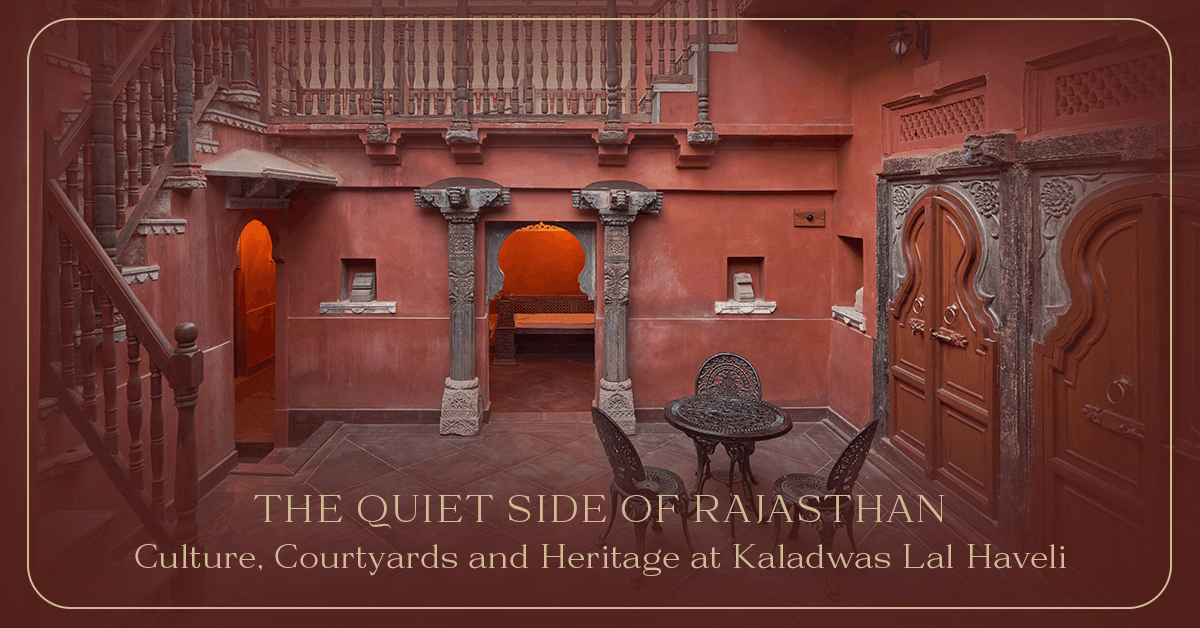
The Quiet Side of Rajasthan: Culture, Courtyards and Heritage at Kaladwas Lal Haveli
Rajasthan is often introduced through its grandest images: monumental forts, elaborate palaces, colourful bazaars and busy streets filled with visitors. They are important parts of the region’s identity, but they are not the whole story.
There is another Rajasthan that reveals itself more slowly.
It can be found in the shade of a courtyard, in the details of an old doorway, in the proportions of a traditional room, in the sound of a neighbourhood waking up, or in an afternoon spent without a packed sightseeing schedule.
This quieter side is particularly easy to appreciate in a historic heritage haveli in Udaipur, where architecture and everyday life remain closely connected. At Kaladwas Lal Haveli, a restored 300-year-old haveli, the experience is shaped around that sense of place. The property brings together its historic character, Mewari influences and boutique hospitality within Udaipur’s Old City.
For travellers who want to understand Rajasthan beyond its famous landmarks, this slower perspective can be just as rewarding.
What Does the Quiet Side of Rajasthan Really Mean?
The quiet side of Rajasthan is not necessarily about finding places where nobody else is present.
It is about changing the way you look at the destination.
Instead of moving quickly from one monument to another, you begin paying attention to the smaller details: how old buildings are arranged, how light enters a courtyard, how local streets change throughout the day, or how traditional design continues to influence contemporary hospitality.
This way of travelling leaves room for observation.
A morning does not have to be measured by how many attractions you have visited. An hour sitting in a shaded courtyard can tell you something about architecture and climate. A walk through an older neighbourhood can reveal details that would be invisible from a vehicle.
For the culturally curious traveller, these quieter moments often provide a more personal understanding of Rajasthan.
Why Courtyards Matter in Rajasthan’s Heritage Architecture
A courtyard may appear simple: an open space surrounded by rooms.
Architecturally, however, it can play several roles.
Traditional courtyards create a relationship between open sky and enclosed interiors. They allow daylight into the building and can influence ventilation and movement. Just as importantly, they provide a central space around which everyday activities can be organised.
In a haveli, the courtyard can also shape the rhythm of the building.
Rooms open towards it. Doorways frame it. Shadows move across it as the day progresses.
This makes the courtyard an architectural feature that changes with time rather than remaining visually fixed.
At Kaladwas Lal Haveli, courtyards form part of the property’s heritage character. The hotel’s positioning around heritage architecture, restored spaces and traditional details reflects the idea that the building itself should remain part of the guest experience.
For a visitor, this creates an opportunity to appreciate architecture through experience rather than simply through photographs.
A Haveli Tells Its Story Through Details
The character of a traditional haveli rarely depends on one spectacular feature.
It emerges through accumulation.
A doorway leads into an interior space. An arch creates a transition. A jharokha frames an opening towards the outside. Carved details reward closer attention. A courtyard brings the sky into the middle of the building.
These elements create layers.
This is one reason heritage accommodation can feel so different from a standardised hotel. In a contemporary hotel designed according to a consistent template, the room may be the primary experience. In a historic haveli, the building itself has a stronger visual and spatial personality.
At Kaladwas Lal Haveli, the traditional architectural identity is an important part of the property’s positioning. The hotel is presented as a restored 300-year-old heritage property where historic character and modern comfort coexist.
The experience therefore begins before a guest even settles into a room.
Culture Is Often Found in Everyday Spaces
When people think about experiencing Rajasthan’s culture, major monuments and formal attractions naturally come to mind.
But culture also exists in ordinary spaces.
It is visible in architectural traditions, food, crafts, neighbourhood life and the ways people use shared and private spaces.
This is particularly noticeable in historic parts of Udaipur.
The Old City does not feel like a museum separated from contemporary life. Its streets remain part of the city’s daily rhythm. Shops open, residents move through the lanes, religious spaces continue their routines and visitors share the same environment.
Staying in a boutique hotel in Udaipur’s Old City allows a traveller to experience this setting at a slower pace.
Instead of visiting the historic city for a few hours and leaving, you return to it at different times of day.
Morning feels different from afternoon.
Evening feels different again.
That repeated exposure is valuable because destinations become more familiar when you stop experiencing them as a checklist.
The Appeal of a Heritage Stay
A heritage stay offers something that a newly constructed property cannot easily reproduce: continuity.
The building existed before the guest arrived.
Its proportions, materials, architectural details and spatial arrangement belong to a longer history. When such a property is restored thoughtfully, those characteristics can remain visible while the building is adapted for contemporary use.
For travellers, the appeal is not about pretending to live in another century.
It is about being surrounded by evidence of the past while enjoying the conveniences expected today.
This balance is central to the modern heritage hotel experience.
At Kaladwas Lal Haveli, the heritage positioning is closely connected with its 300-year-old haveli identity, its Mewari and Rajasthani character, and its role as a small, intimate boutique property.
The result is a stay that feels connected to its destination rather than interchangeable with a hotel in another city.
Seven Rooms, Seven Interpretations of Rajasthan
Boutique hospitality becomes particularly interesting when individuality extends into the accommodation itself.
Kaladwas Lal Haveli has seven themed suites, giving the property an opportunity to express different aspects of Rajasthan and Mewar through its rooms.
That approach is different from treating rooms as identical units.
For travellers, it creates another layer of discovery.
The room is no longer simply where you return after sightseeing. Its design becomes part of the context of the trip.
This is especially appropriate for a heritage property. When the surrounding destination has such a strong architectural and cultural identity, accommodation can either ignore that identity or respond to it.
A thoughtfully designed boutique hotel chooses the latter.
A Different Pace for Exploring Udaipur
The quieter side of Rajasthan becomes easier to appreciate when you resist the pressure to see everything.
Udaipur rewards this approach.
Spend time exploring the historic lanes rather than moving directly between major attractions. Notice the architectural details above eye level. Pause at a ghat. Browse local shops without turning every stop into a purchase. Allow yourself time to return to the hotel before heading out again.
The objective is not to avoid the city’s famous sights.
It is to leave enough space around them.
A stay at a heritage property can support this rhythm because the accommodation itself gives you something worth lingering in.
The Old City becomes more than a location on a map.
It becomes part of your daily surroundings.
What Should Travellers Look For in a Heritage Stay?
Choosing a heritage property is about more than finding a building that looks old.
If the architectural and cultural experience matters to you, consider a few questions before booking:
Does the property have a genuine story?
Look for clear information about the building’s history and heritage positioning.
Has its character been preserved?
Traditional architecture should remain visible rather than being completely covered by contemporary styling.
Does the property reflect its destination?
Look for connections with local architecture, food, crafts or cultural traditions where appropriate.
Is the location meaningful?
A property within or near a historic neighbourhood can make it easier to experience the destination beyond major attractions.
Does the hotel still provide contemporary comfort?
Heritage accommodation should not require you to sacrifice basic convenience simply because the building is historic.
These considerations help distinguish a genuine heritage experience from a hotel using traditional decoration as a theme.
Kaladwas Lal Haveli: A Quieter Way to Experience Udaipur
At Kaladwas Lal Haveli, the idea of a quieter Rajasthan begins with the building itself.
The property is positioned as a restored 300-year-old heritage haveli and boutique hotel in Udaipur, rooted in Mewari and Rajasthani heritage. Its setting in the historic Old City adds another layer, connecting the stay with the wider architectural and cultural environment of Udaipur.
This makes the haveli particularly relevant for travellers who are interested in the destination beyond its headline attractions.
You can explore Udaipur during the day, then return to a property whose own character continues the story.
The transition matters.
Instead of leaving the heritage experience behind when you return to your accommodation, you remain surrounded by it.
That is one of the strongest arguments for choosing a heritage boutique hotel in Udaipur.
When Staying Becomes Part of Understanding
There is a certain kind of traveller who remembers a destination through its smaller moments.
Not only the palace was viewed from a distance, but the doorway passed several times each day.
Not only the famous lake, but the changing light around it.
Not only the historic architecture seen during sightseeing, but the courtyard where you sat quietly afterwards.
These details accumulate.
Over time, they become the texture of a trip.
That is what a heritage stay can offer. It does not replace the experience of exploring Rajasthan. It gives that exploration another context.
At Kaladwas Lal Haveli, the property’s heritage identity, boutique scale and connection with Mewari culture provide a setting in which the accommodation becomes part of the destination experience rather than simply a place to sleep.
The Beauty of Going Slowly
The quiet side of Rajasthan is not a different Rajasthan.
It is Rajasthan viewed without rushing.
It is found in the spaces between major attractions, in architectural details that reward attention, in courtyards shaped by climate and social life, and in historic buildings that continue to have a purpose in the present.
A heritage stay in Udaipur can make these details easier to appreciate because the story does not end when sightseeing does.
At Kaladwas Lal Haveli, the setting of a restored 300-year-old haveli brings together architecture, boutique hospitality and the cultural character of Mewar.
And perhaps that is the most rewarding way to discover the quieter Rajasthan: not by searching for somewhere completely untouched by visitors, but by giving yourself enough time to notice what is already there.
Sometimes the most memorable part of a journey is the moment when you stop looking for the next attraction—and simply look around.
FAQs
What is the quiet side of Rajasthan?
The quiet side of Rajasthan refers to experiences beyond its major tourist attractions. It can include historic neighbourhoods, traditional architecture, courtyards, local food, crafts and slower moments that allow travellers to observe everyday cultural life.
Why are courtyards important in Rajasthani architecture?
Courtyards create open spaces within traditionally enclosed buildings. They can bring daylight and air into interiors while also providing central spaces around which different parts of a haveli are arranged.
Why choose a heritage boutique hotel in Udaipur?
A heritage boutique hotel can connect accommodation with the architecture and cultural identity of the destination. Instead of staying in a standardised environment, travellers can experience a property whose design and history contribute to their understanding of Udaipur.
What makes Kaladwas Lal Haveli a heritage stay?
Kaladwas Lal Haveli is positioned as a restored 300-year-old heritage haveli and boutique hotel in Udaipur, with a strong connection to Mewari and Rajasthani heritage and a location within the historic Old City.
Is a heritage stay suitable for travellers who want modern comfort?
Yes. A heritage property can retain historic character while being adapted for contemporary hospitality. The balance between preserving the building’s identity and providing modern comfort is an important part of the boutique heritage hotel experience.