
Reception: +91-830 290 2727
Office: +91-830 290 2727
E-mail: kaladwaslalhaveli@gmail.com
Address: 96, Chawra House Ganesh Ghati Udaipur, Rajasthan 313001
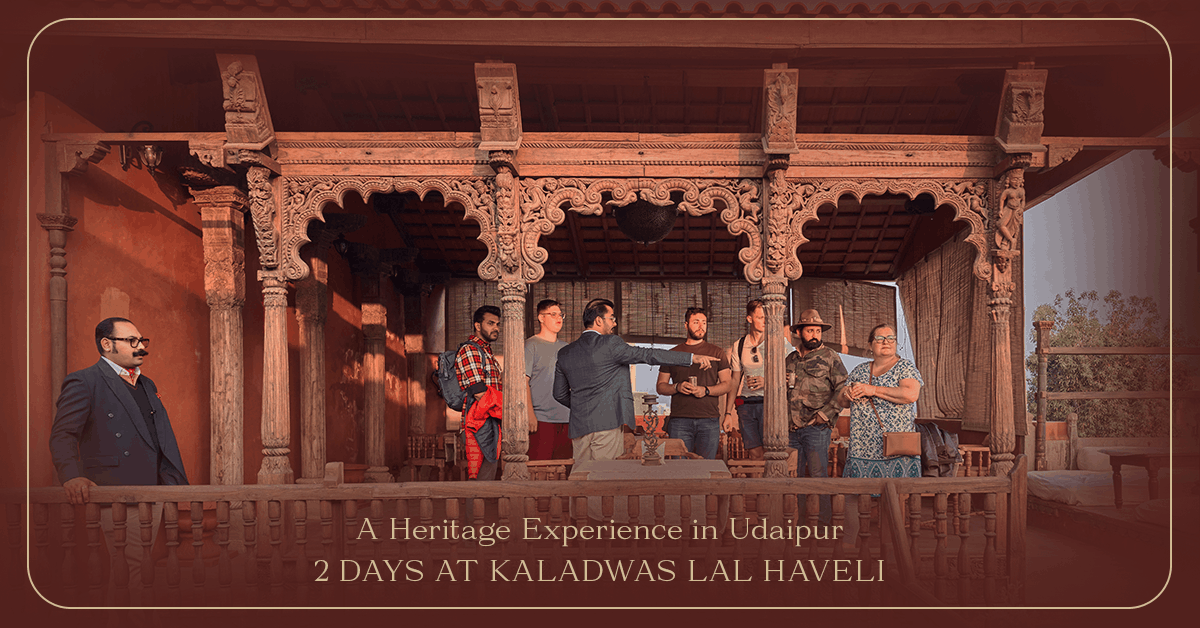
A Heritage Experience in Udaipur: 2 Days at Kaladwas Lal Haveli
Udaipur is often introduced through its most recognisable images: palaces reflected in quiet lakes, ornate courtyards, red sandstone facade with traditional carvings and sunsets over Lake Pichola. These are essential parts of the city, but they are only one layer of its identity.
Beyond the landmarks is another Udaipur—one found in temple bells at the start of the day, old trading streets, family-run shops, traditional kitchens, artisan workshops and recipes carried from one generation to the next.
To experience this side of the city, where heritage is still part of everyday life, where you stay matters.
At Kaladwas Lal Haveli, the experience begins within the old city itself. Over two days, a stay can unfold not simply as a sightseeing itinerary, but as a gradual introduction to the architecture, food, craftsmanship, rituals and stories that continue to shape Udaipur.
Here is what 48 hours can look like when the city is experienced from within its heritage.
DAY ONE: ENTERING THE OLD CITY
A Slow Morning at the Haveli
The first morning begins without the urgency of a conventional sightseeing schedule.
Breakfast at Kaladwas Lal Haveli offers a chance to notice the character of the house itself—the old stone, timber, carved details and quiet spaces that create the atmosphere of a traditional Udaipur home. There is something appropriate about beginning a heritage journey by simply spending time inside a heritage setting.
Soon, the city outside begins to call.
Step into Ganesh Ghati and the rhythm changes. Shops are beginning to open, residents are starting their day and the narrow lanes gradually become more active. The old city does not feel like a monument waiting to be visited. It feels lived in.
That distinction becomes important throughout the day.
From Jagdish Temple to the Old City’s Trading Streets
A morning walk towards Jagdish Temple brings another dimension to Udaipur’s heritage. The temple is not simply an architectural attraction; it remains an active place of worship, with prayers, bells and devotees forming part of the morning atmosphere.
From here, continue towards the lanes around Ghantaghar and Bada Bazar.
This is where Udaipur’s commercial traditions become visible. Jewellery shops, spice merchants, textile stores, antique dealers and traditional workshops occupy streets where trade and craftsmanship have long been part of everyday life.
For a traveller, the pleasure is often in slowing down enough to notice the details: a shopkeeper arranging pieces in a display, the scent of spices from a nearby store, an intricately worked piece of jewellery or the textures of traditional textiles.
These encounters reveal a side of the city that a list of monuments cannot fully capture.
A Taste of the Old City
Food provides another way into local culture.
A small stop at Lala Misthan Bhandar for a traditional sweet or savoury is less about ticking a restaurant off an itinerary and more about experiencing the familiar flavours of the old city.
In Udaipur, food can carry memory in much the same way as architecture does. A recipe, preparation or sweet can connect generations to a particular place and way of life.
After a morning among the streets and markets, returning to Kaladwas Lal Haveli offers a welcome change of pace.
AFTERNOON: SLOWING DOWN AT THE HAVELI
The afternoon is deliberately slower.
There is time to rest, spend a quiet moment in the courtyard or library, and appreciate the architecture without having somewhere else to reach.
Then comes a more intimate introduction to Rajasthan through a Mewari cooking experience.
Rather than simply sitting down to a regional meal, guests can discover the ingredients, methods and culinary traditions behind it. Traditional recipes often reveal as much about a place as its monuments do—particularly when techniques and flavours have been passed through families over time.
The experience brings Mewari cuisine closer to its origins, allowing food to become part of the story of the stay.
EVENING: GANGAUR GHAT AND LAKE PICHOLA
As afternoon gives way to evening, Udaipur invites you back towards the water.
Gangaur Ghat is particularly atmospheric in the hour before sunset. Along the edge of Lake Pichola, everyday movement continues—people gathering, conversations taking place and local rituals unfolding as the light gradually changes.
The lake is certainly beautiful, but the experience is not only about the view. It is about seeing how closely the water, the old city and daily life remain connected.
Eventually, it is time to return to the haveli.
NIGHT: ROOFTOP DINING AT KALADWAS LAL HAVELI
As darkness settles over Udaipur, the rooftop at Kaladwas Lal Haveli becomes a different kind of vantage point.
Traditional Mewari flavours arrive at the table while Langa folk musicians provide the evening’s soundtrack. Around them are old rooftops, the Clock Tower, temple sounds and the subtle movement of the neighbourhood after sunset.
It is less a dinner overlooking Udaipur than a dinner held within it.
That is perhaps the most fitting way to end the first day. You have not simply visited the old city. You have begun to understand its rhythm.
DAY TWO: DISCOVERING THE CITY BENEATH THE SURFACE
The second day goes deeper.
If the first day introduces the old city through its streets, temples, markets and food, the second looks more closely at the people and traditions that keep its character alive.
MORNING: UNEXPLORED UDAIPUR HERITAGE WALK
Begin with Kaladwas Lal Haveli’s Unexplored Udaipur Heritage Walk.
Rather than following only the city’s familiar sightseeing circuit, the walk moves through older trading streets, temples, artisan neighbourhoods and working bazaars.
The experience is less about collecting photographs of historic buildings and more about understanding what happens inside them.
Along the way, travellers can encounter the people behind some of Mewar’s traditional crafts. A silversmith working on intricate jewellery, a miniature painter using exceptionally fine brushes or a metalworker practising techniques such as Kansara, Koftkaari and Sigligari can offer a different perspective on what heritage really means.
These traditions are not simply performances created for visitors. They represent skills, occupations and forms of craftsmanship that continue to have a place in everyday life.
Seeing that process firsthand makes heritage feel considerably less distant.
When the Morning Returns to the Table
After the walk, return to Kaladwas Lal Haveli for a specially curated brunch inspired by the morning’s discoveries.
There is a natural connection between what happens in the streets and what appears at the table.
A conversation about ingredients, the aroma of a spice market, an observation about local food or an encounter with traditional craftsmanship can change the way a meal is experienced.
Here, cuisine becomes another form of storytelling.
The morning has been about discovering Udaipur through its people and streets. Brunch allows some of those impressions to be understood through flavour.
AFTERNOON: UDAIPUR’S ROYAL HERITAGE
The afternoon turns towards the grander side of the city.
The City Palace offers an opportunity to explore the architectural and historical layers of Mewar through its courtyards, galleries, decorative details and interconnected spaces. Unlike the smaller discoveries of the morning, its scale makes the history of Udaipur feel monumental.
Yet the two experiences complement one another.
The palace represents the royal history of Mewar; the old-city streets reveal the everyday traditions that continued around it.
From there, continue to Bagore Ki Haveli.
Its rooms, objects and architectural details provide another perspective on the city’s domestic and aristocratic past. Together, these spaces help create a fuller understanding of Udaipur—not as a collection of isolated attractions, but as a city shaped by different layers of life.
WALKING BACK THROUGH THE OLD CITY
Some of the best moments of the afternoon may come after the major sights have been seen.
Instead of taking the quickest route back, wander through the old city.
Look for a carved doorway that might otherwise be missed. Pause outside a perfume shop. Notice textiles displayed by a local merchant. Watch a miniature painting taking shape inside a studio. Spend a few moments with a jeweller whose craft reflects a much older tradition.
These are small encounters, but they are often the ones that remain in memory.
The most memorable parts of Udaipur are sometimes found between the major landmarks.
A casual pause at Purana Shehar Café can continue this exploration through familiar snacks, drinks and everyday preparations associated with old-city life.
It offers a useful contrast to the more curated experiences of a heritage stay: one is formal and immersive, the other casual and ordinary. Both belong to the same city.
FINAL EVENING: SEVEN-COURSE MEWARI TASTING
For the final evening, return to Kaladwas Lal Haveli.
The seven-course Mewari tasting brings the two days together through food.
Each course can introduce a different aspect of the region’s culinary memory—its ingredients, methods, flavours and stories. Alongside the meal, folk songs and storytelling add another layer, connecting what is on the plate with the oral traditions through which culture is often remembered and passed on.
By this point, Mewari cuisine is no longer simply something you have tasted.
It has become part of a larger story involving the markets you walked through, the ingredients you encountered, the crafts you saw and the traditions you heard about.
Food, music, architecture and memory meet around the same table.
Conclusion: Experiencing Udaipur, Not Just Seeing It
Forty-eight hours cannot reveal everything Udaipur has to offer, nor should it try to.
The value of a two-day heritage experience lies in allowing enough time to notice what exists beyond the obvious.
After two days, the city begins to feel like more than lakes and palaces. It becomes a place of temple bells and old recipes, working craftsmen and neighbourhood bazaars, carved façades and family traditions, folk music and stories passed between generations.
This is where staying at Kaladwas Lal Haveli changes the experience.
For travellers considering boutique hotels in Udaipur, location is not only about convenience. It can shape how much of the city you actually experience.
At Kaladwas Lal Haveli, the haveli is not simply where the journey begins and ends. It sits within the very fabric of the old city being explored.
You can step out from your room and enter streets where daily life continues around centuries-old architecture. You can return from the city to a courtyard, a Mewari meal or an evening of music without leaving the heritage atmosphere behind.
And perhaps that is what makes a heritage stay different from simply staying in a heritage building.
It allows Udaipur to become part of the stay—and the stay to become part of the experience of Udaipur.
Frequently Asked Questions
1. Is 2 days enough to experience Udaipur?
Yes. Two days can offer a meaningful introduction to Udaipur, especially when the itinerary combines its famous heritage sites with old-city walks, local markets, traditional cuisine, artisan experiences and time spent within the historic neighbourhoods.
2. What can you experience in Udaipur beyond the main tourist attractions?
Beyond places such as the City Palace and Lake Pichola, travellers can explore old trading streets, temples, traditional bazaars, artisan workshops, local food traditions, folk music and everyday neighbourhood life.
3. What makes a heritage stay in Udaipur different from a regular hotel stay?
A heritage stay can offer a stronger connection to the city’s history and character through architecture, traditional cuisine, local experiences and its setting within historic neighbourhoods. At Kaladwas Lal Haveli, the stay is closely connected with the old city and its surrounding heritage.
4. What is a Mewari heritage experience?
A Mewari heritage experience brings together elements of the region’s culture, including traditional cuisine, local crafts, music, architecture, stories and everyday customs. It allows travellers to understand Mewar through more than its monuments.
5. What are some places to visit in Udaipur in two days?
A two-day Udaipur experience can include the City Palace, Jagdish Temple, Bagore Ki Haveli, Gangaur Ghat, Lake Pichola, Ghantaghar and Bada Bazar, along with time for exploring the old city’s smaller streets, markets and artisan areas.
6. Why choose a boutique hotel in Udaipur for a heritage-focused trip?
A boutique hotel can provide a more intimate experience of the city, particularly when it is located within or close to the historic old city. It can also combine accommodation with locally rooted experiences such as regional food, heritage walks, architecture and cultural activities.