

Reception: +91-830 290 2727
Office: +91-830 290 2727
E-mail: kaladwaslalhaveli@gmail.com
Address: 96, Chawra House Ganesh Ghati Udaipur, Rajasthan 313001
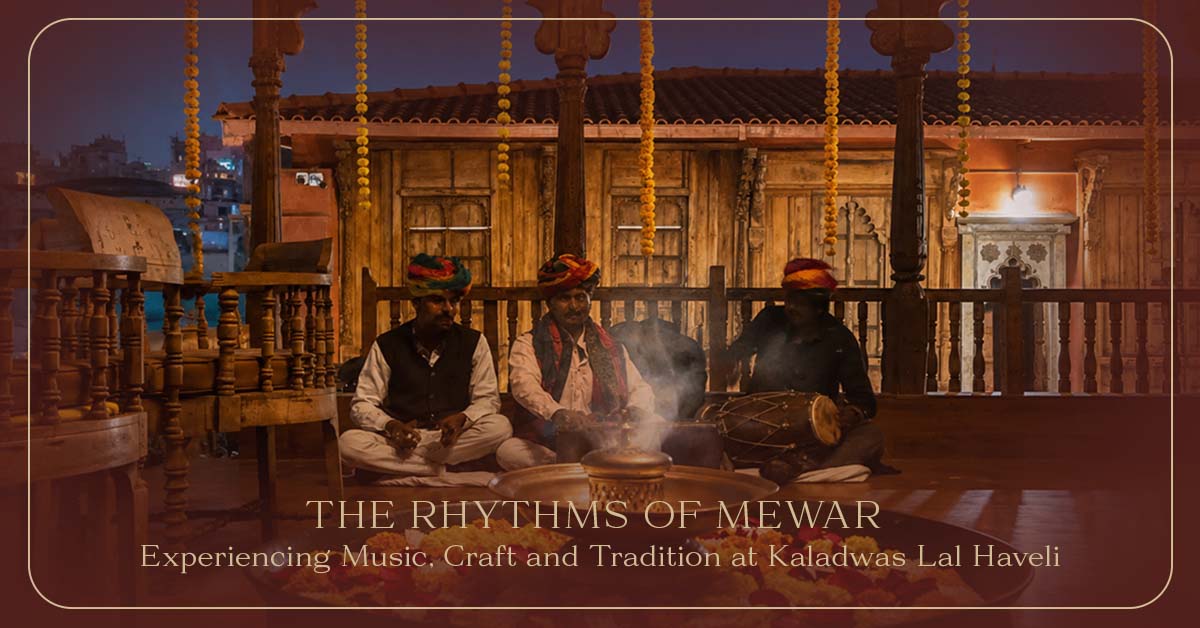
The Rhythms of Mewar: Experiencing Music, Craft and Tradition at Kaladwas Lal Haveli
Mewar is often remembered through the grand silhouette of its palaces, the strength of its forts, and the lakes that define Udaipur’s landscape. But the character of this historic region extends far beyond monumental architecture.
It lives in the sound of traditional music, the patience of an artisan’s hands, the details carved into an old doorway, the flavors served at a family table, and the warmth with which guests are welcomed.
These are the quieter expressions of Mewar—traditions that continue not because they are preserved behind glass, but because they remain connected to everyday life.
For travelers looking for a more meaningful experience of Rajasthan, a Heritage Stay in Udaipur can offer an opportunity to encounter these traditions at a slower, more intimate pace. At a historic property such as Kaladwas Lal Haveli, the setting itself becomes part of that cultural experience.
Mewar Is More Than Its Monuments
Udaipur’s heritage is immediately visible. The City Palace, historic temples, lakes, ghats, and old neighborhoods tell stories that have shaped the identity of Mewar for generations.
Yet cultural heritage is not limited to buildings.
It also exists in the things people create, perform, cook, teach, and pass down.
Traditional music carries stories and emotions. Handcrafted objects preserve techniques learned over generations. Regional cuisine reflects local ingredients and traditions. Architecture reveals how communities adapted their homes to climate and lifestyle. Hospitality expresses the importance placed on welcoming others.
Together, these elements create a more complete picture of Mewar.
For travelers, this means that understanding Udaipur does not necessarily require moving from one monument to another. Sometimes, it means paying attention to the details that surround those monuments—and choosing accommodation that allows the city’s cultural character to remain part of the journey.
The Musical Heritage of Mewar
Music has long been an important part of Rajasthan’s cultural landscape.
Across the region, traditional performers have used music to accompany celebrations, devotional occasions, storytelling, and community gatherings. Folk traditions have helped preserve stories and cultural memories, often passing them from one generation to another through performance rather than written records.
The sound of Rajasthan is also closely connected with its traditional instruments and distinctive vocal styles. Different communities and regions have developed their own musical practices, contributing to the extraordinary diversity of the state’s folk traditions.
In Mewar, music can therefore be understood not simply as entertainment but as another form of cultural memory.
For a traveler, encountering traditional Rajasthani music—whether through a cultural performance, a local celebration, or a conversation about regional traditions—can provide a different perspective on the destination.
It reveals an emotional side of heritage that architecture alone cannot communicate.
When Craftsmanship Becomes a Living Heritage
If music allows Mewar’s stories to be heard, craftsmanship allows them to be seen.
Rajasthan is renowned for its diverse artisan traditions, including stonework, wood carving, textiles, decorative arts, painting, metalwork, and handcrafted objects. These traditions have contributed to the visual character of homes, temples, palaces, and havelis throughout the region.
The value of traditional craftsmanship lies not only in the finished object.
It is also in the knowledge behind it.
A particular technique may require years of practice. A decorative pattern may reflect a regional aesthetic. The choice of material may respond to the local environment. The way an object is made can reveal a relationship between craftsmanship, utility, and beauty.
This is particularly meaningful when experienced within a Rajasthani Haveli.
Instead of seeing traditional craft as something separate from architecture, travelers can notice how handcrafted details become part of the building itself—through doors, furniture, decorative elements, textiles, and other features.
The result is an environment where heritage feels tangible.
Architecture as a Language of Mewar
A historic haveli speaks in its own visual language.
Courtyards, arches, jharokhas, carved doors, stone surfaces, shaded spaces, and traditional materials are not simply decorative features. They reflect the ways people once used and experienced their homes.
Courtyards, for example, could create a shared space within the household while allowing light and air to move through the building. Windows and shaded openings could balance privacy with ventilation. Traditional materials responded to local conditions while also providing opportunities for craftsmanship.
This relationship between function and beauty is one reason heritage architecture continues to fascinate modern travelers.
A Heritage Boutique Hotel in Udaipur offers a particularly intimate way to experience this architecture.
Instead of observing a historic building for an hour during sightseeing, guests can spend an entire stay surrounded by its proportions, textures, details, and atmosphere.
The building becomes something to notice slowly.
The Everyday Traditions of Mewar
Culture is often easiest to understand through ordinary experiences.
A local market, a traditional meal, a handcrafted object, a neighborhood celebration, or the way guests are welcomed can reveal as much about a destination as a famous monument.
Mewar’s traditions are similarly connected to everyday life.
Food is one example. Regional dishes and cooking practices reflect local ingredients, climate, history, and community traditions. Traditional textiles and crafts provide another connection to regional identity. Festivals and religious practices bring communities together and keep cultural customs visible across generations.
For travelers, these experiences can make a destination feel more personal.
Instead of simply learning about Mewar, they begin to understand something of how Mewar is lived.
Hospitality as a Cultural Tradition
Hospitality is another important part of Rajasthan’s identity.
The experience of being welcomed, guided, and cared for can influence how travelers remember a destination just as strongly as the places they visit.
At a smaller Boutique Hotel in Udaipur, hospitality can feel particularly personal. Recommendations can be tailored to a guest’s interests, conversations can happen naturally, and the experience can feel connected to the people and place rather than following a completely standardized pattern.
In a heritage setting, the surroundings reinforce that feeling.
A traditional courtyard, a historic interior, a locally inspired meal, or a rooftop view can create a sense of continuity between the hotel and the destination beyond its doors.
This is where hospitality becomes more than service.
It becomes part of the cultural experience.
Experiencing Mewar Through a Heritage Haveli
There is a difference between visiting heritage and staying within it.
A palace or fort can introduce travelers to the political and architectural history of Rajasthan. A museum can preserve important objects and stories.
But a Haveli Stay in Udaipur provides another perspective.
You wake up inside a historic environment. You notice architectural details during ordinary moments rather than during a guided tour. You return to the same courtyard after exploring the city. You experience hospitality in a setting shaped by traditions that existed long before contemporary tourism.
This slower interaction allows heritage to become familiar.
The aim is not to recreate the past exactly as it was. A thoughtfully restored heritage property combines the character of an older building with the comfort expected by today’s travelers.
That balance is essential.
Heritage remains meaningful when it can be appreciated without becoming disconnected from modern life.
The Rhythms of Mewar at Kaladwas Lal Haveli
Kaladwas Lal Haveli offers a natural setting for travelers interested in experiencing Udaipur through this broader understanding of heritage.
The property is a 300-year-old heritage haveli in Udaipur’s Old City, where historic character and contemporary hospitality come together. Its setting places guests close to the city’s historic environment, allowing the experience of the haveli to continue naturally into the surrounding streets and cultural landmarks.
Rather than treating heritage as a separate attraction, the property provides an environment where travelers can appreciate traditional architecture, craftsmanship, hospitality, and the atmosphere of the Old City as part of their stay.
Its rooftop experience also offers another way to observe Udaipur from within its historic setting.
The significance of a property like Kaladwas Lal Haveli is therefore not simply its age.
It is the opportunity to experience a historic building as part of contemporary travel while remaining connected to the cultural landscape of Mewar.
Why Cultural Experiences Matter to Modern Travelers
Travelers today are increasingly interested in experiences that feel connected to the places they visit.
They want to understand local food, meet artisans, explore historic neighborhoods, discover regional traditions, and stay in properties that have a genuine relationship with their destination.
This is one reason heritage accommodation has become so appealing.
A Heritage Stay in Udaipur can provide a natural starting point for cultural exploration. Instead of separating accommodation from the destination, it allows the two to complement each other.
The experience can become slower and more observant.
A traveler may begin noticing the craftsmanship in an old building, listening more carefully to local music, asking questions about regional food, or taking an interest in the traditions behind objects they encounter.
These moments may not appear on a conventional sightseeing itinerary.
Yet they often become the experiences that remain longest in memory.
Keeping the Rhythms of Mewar Alive
Mewar’s heritage is not confined to monuments.
It can be heard in music, seen in craftsmanship, tasted through regional cuisine, expressed through architecture, and felt through hospitality.
These traditions give Udaipur a cultural identity that extends beyond its most photographed landmarks.
For travelers, experiencing them does not necessarily require a complicated itinerary. Sometimes, it begins with choosing a place to stay that has a genuine connection with the history and character of the destination.
A Heritage Boutique Hotel in Udaipur can provide that connection—a place where architecture becomes part of the stay, hospitality reflects the spirit of the region, and the surrounding city can be explored at a more thoughtful pace.
At Kaladwas Lal Haveli, the story of Mewar is not presented as something frozen in the past. It forms part of the atmosphere in which contemporary travelers experience Udaipur.
And perhaps that is the most meaningful way to understand heritage: not simply by looking back at what Rajasthan once was, but by noticing how its traditions continue to shape the way the region sounds, looks, tastes, and welcomes its guests today.
FAQs
1. What is Mewar known for?
Mewar is known for its rich history, distinctive architecture, folk traditions, music, craftsmanship, cuisine, and cultural heritage. Udaipur, its most prominent city, offers travelers opportunities to experience these traditions alongside its famous palaces, lakes, temples, and historic neighborhoods.
2. What is Mewari culture?
Mewari culture refers to the traditions and way of life associated with the Mewar region of Rajasthan. It includes regional music, crafts, cuisine, festivals, architecture, art, and hospitality traditions that have developed and evolved across generations.
3. How can travelers experience Mewari culture in Udaipur?
Travelers can experience Mewari culture by exploring Udaipur’s historic neighborhoods, visiting temples and heritage sites, discovering local crafts and markets, trying regional cuisine, experiencing traditional music, and choosing a Heritage Stay in Udaipur that has a genuine connection with the city’s historic character.
4. Why choose a heritage boutique hotel in Udaipur?
A Heritage Boutique Hotel in Udaipur allows travelers to experience traditional architecture and local character while enjoying contemporary comforts. Staying in a historic setting can make the accommodation itself an important part of the cultural experience.
5. What makes a Haveli Stay in Udaipur special?
A Haveli Stay in Udaipur offers the opportunity to stay within a property shaped by traditional architecture, craftsmanship, and history. Rather than simply viewing heritage during sightseeing, guests can experience it as part of their everyday stay.
6. How does Kaladwas Lal Haveli connect travelers with Mewar’s heritage?
Kaladwas Lal Haveli is a 300-year-old heritage haveli in Udaipur’s Old City. Its historic setting, architecture, boutique hospitality, and connection with the surrounding heritage environment provide travelers with an intimate way to experience the cultural character of Udaipur and Mewar.