

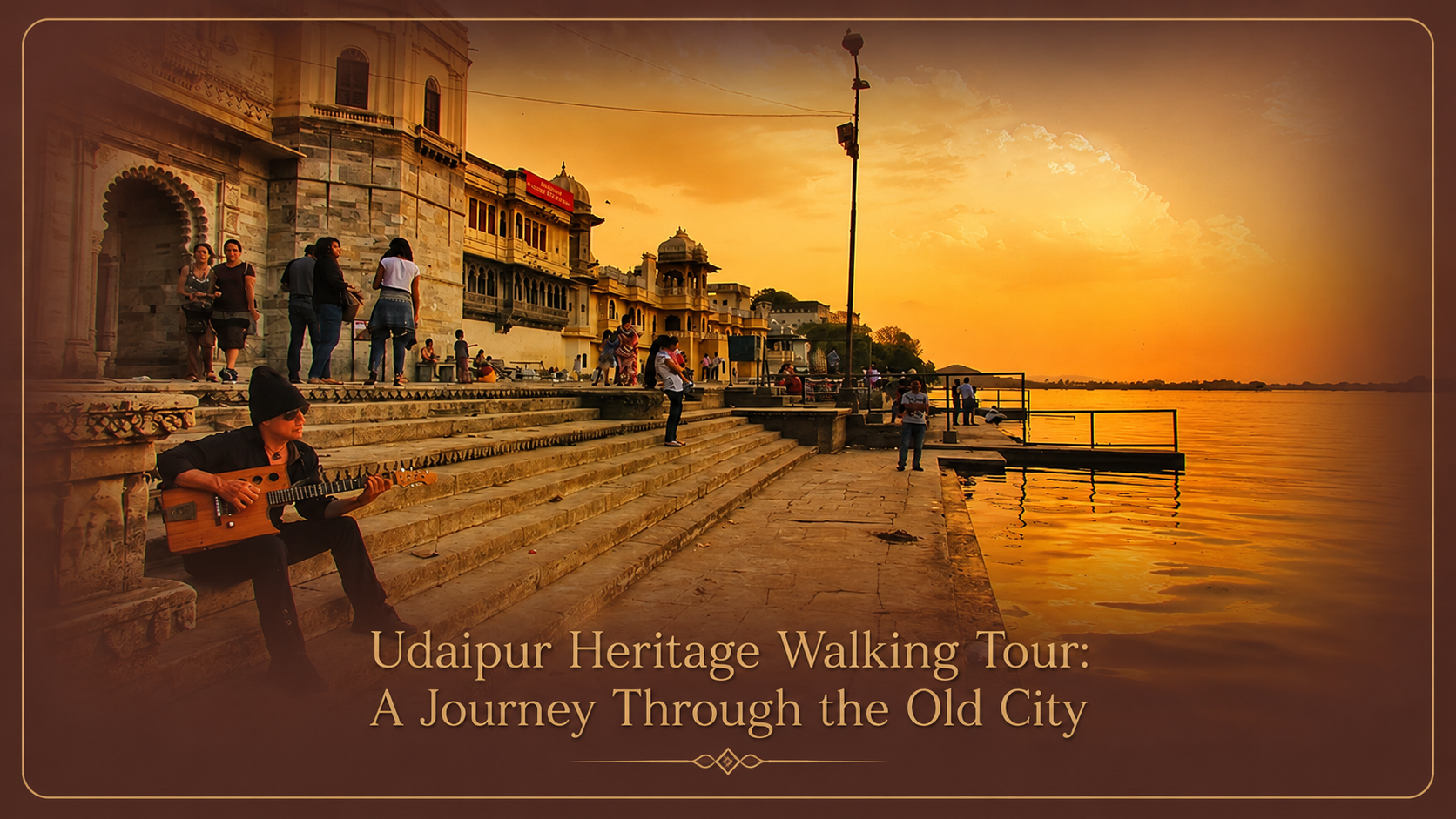

Udaipur Heritage Walking Tour: A Journey Through the Old City
Udaipur is often experienced through its palaces and lakes, but some of the city's most interesting stories are found on foot. A walk through the Old City takes you past historic temples, royal architecture, traditional havelis, colourful markets, old residential streets and lakeside ghats—all within a relatively compact area.
A Udaipur heritage walking tour is one of the best ways to understand how the city developed around the royal centre of Mewar. Instead of simply moving between attractions by car, walking allows you to notice the smaller details: carved doors, jharokhas, traditional façades, narrow lanes, local shops and everyday life around historic buildings.
This guide takes you through a practical self-guided heritage route, explains what to see at each stop, and shares tips for making the most of a walk through Udaipur's Old City.
What Is a Udaipur Heritage Walking Tour?
A heritage walking tour is a guided or self-guided walk through historically important parts of a city.
In Udaipur, the most rewarding heritage walks generally focus on the Old City and the area around the City Palace, Jagdish Temple, Bagore Ki Haveli, historic streets, ghats and Lake Pichola.
The purpose isn't simply to cover as many attractions as possible.
It is to understand how the different parts of the historic city connect:
Royal palace → temple → old neighbourhoods → haveli → market → ghat → lake
This makes walking particularly useful for travellers who want to understand Udaipur's history and architecture rather than simply collect photographs.

Why Explore Udaipur on Foot?
Udaipur's Old City has narrow lanes and closely packed historic buildings that are often better appreciated at walking pace.
From a vehicle, you may notice a palace or temple.
On foot, you start noticing everything in between.
You can see traditional doors, balconies, small shrines, old façades, local workshops, shops and architectural details that might otherwise be missed.
Walking also allows you to stop whenever something catches your attention.
That flexibility is one of the biggest advantages of a heritage walk.
What Can You See on a Udaipur Heritage Walk?
Depending on the route you choose, a heritage walk can include:
- City Palace
- Jagdish Temple
- Jagdish Chowk
- Traditional Old City streets
- Historic havelis
- Bagore Ki Haveli
- Gangaur Ghat
- Lake Pichola
- Ambrai Ghat
- Traditional markets
- Local food and cafés
- Rajput architectural details
A short route can cover the main highlights, while a longer walk gives you more time to explore the neighbourhoods between them.
Udaipur Heritage Walking Tour Route
For first-time visitors, this route provides a practical introduction to the historic centre: City Palace → Jagdish Temple → Jagdish Chowk → Old City Streets → Bagore Ki Haveli → Gangaur Ghat → Lake Pichola → Ambrai Ghat. You can complete the core route in several hours, depending on how long you spend at each attraction. If you want a slower experience with photography, food and shopping stops, consider setting aside most of a day.
Stop 1: City Palace
Suggested time: 1.5–2.5 hours
Start your heritage walk at the City Palace, one of the most important historical landmarks in Udaipur.
The palace complex developed over several generations of Mewar's rulers after Udaipur became the capital in the 16th century.
Rather than thinking of the City Palace as one building, look at it as a collection of interconnected structures that evolved over time.
Inside, pay attention to:
- Courtyards
- Jharokhas
- Decorative balconies
- Arched passages
- Marble and stone work
- Traditional paintings
- Historic interiors
- Views over Lake Pichola
The elevated position of parts of the palace also helps explain the relationship between the royal complex, the lake and the surrounding city.
What to look for: Don't rush from one famous room to another. Look closely at the doors, windows, stonework and small decorative details. These often reveal more about traditional architecture than a single panoramic view.
Once you've finished exploring the palace, exit towards the historic streets around Jagdish Temple.
Stop 2: Jagdish Temple
Suggested time: 20–30 minutes
From the City Palace area, continue towards Jagdish Temple.
The temple is one of the most recognisable religious and architectural landmarks in the Old City.
Its detailed stone carvings and vertical architectural form make it particularly interesting for visitors who enjoy historic architecture.
Because the temple remains a place of worship, take a moment to observe local customs rather than treating it simply as another sightseeing stop.
What to look for: Pay attention to the carvings and architectural details around the entrance and exterior. The area around the temple also gives you a good introduction to the character of the Old City, with shops, streets and everyday activity surrounding the historic structure.
Stop 3: Jagdish Chowk
Suggested time: 15–30 minutes
Jagdish Chowk acts as an important connection point between several parts of the Old City.
Instead of immediately moving to the next major attraction, spend a little time exploring the surrounding streets.
This is where the heritage walk becomes different from a conventional sightseeing itinerary.
Look for:
- Traditional buildings
- Painted façades
- Old doors
- Balconies
- Small shrines
- Local shops
- Handicraft stores
- Traditional residential architecture
The Old City is not a preserved museum.
People live and work here, which means historic architecture exists alongside modern daily life.
That combination is part of what makes the area interesting.
Stop 4: Explore the Old City Streets
Suggested time: 30–60 minutes
This is the part of the walk where you should slow down.
Rather than following the fastest route, take a little time to explore some of the smaller lanes around the main tourist streets.
Udaipur's historic streets reveal architectural details that can be easy to overlook.
Look for Traditional Jharokhas
Jharokhas are projecting windows or enclosed balconies associated with traditional architecture in Rajasthan.
They can be both decorative and functional, providing shade, ventilation and views over the street.
Look for Old Doors
Traditional doors can reveal details about the age and character of a building.
Look for carved wood, decorative metalwork, painted surfaces and large entrances.
Look for Courtyard Houses
Many traditional residences were designed around internal courtyards.
These courtyards helped create private open spaces within densely built neighbourhoods.
Look at the Streetscape
Don't focus only on individual buildings.
Notice how houses, shops, temples, balconies and narrow lanes fit together.
This is the historic urban environment that makes the Old City different from a modern neighbourhood.
Stop 5: Bagore Ki Haveli
Suggested time: 45–60 minutes
Continue towards Bagore Ki Haveli, located near Gangaur Ghat.
A haveli offers a different perspective from the grand scale of the City Palace.
Traditional havelis were residential buildings associated with noble families and other prominent households.
Their architecture often included courtyards, balconies, decorative façades and multiple interconnected spaces.
Bagore Ki Haveli can therefore help visitors understand another side of Udaipur's historic built environment.
Why visit a haveli? A palace tells you about royal life. A haveli can provide a better sense of residential architecture and the social environment that developed around the royal centre. For a heritage walking tour, including both gives the experience more depth.
Stop 6: Gangaur Ghat
Suggested time: 30–45 minutes
From Bagore Ki Haveli, continue towards Gangaur Ghat.
The ghat is one of the historic waterfront areas of Udaipur and provides views across Lake Pichola.
This is a good place to take a break from walking.
Rather than treating the ghat as a quick photo stop, spend some time observing the relationship between the waterfront and the surrounding historic buildings.
Why are ghats important? Ghats are more than places to take photographs. Historically, waterfront areas have served religious, cultural and social purposes. In Udaipur, the ghats also demonstrate how closely the city's development is connected with its lakes.
Stop 7: Lake Pichola
Suggested time: 30–60 minutes
No heritage walk through Udaipur is complete without spending time beside Lake Pichola.
The lake is one of the defining elements of the city's landscape.
From the waterfront, you can see historic architecture rising around the lake and appreciate the relationship between the water, palaces and surrounding hills.
If boat rides are operating during your visit, you can consider adding one to your itinerary.
A boat provides a completely different perspective of the historic city.
A better way to experience the lake: Don't simply arrive, take a photograph and leave. Spend a few minutes watching the changing light on the water and looking back towards the historic skyline. Udaipur's architecture makes more sense when seen as part of the landscape rather than as individual buildings.
Stop 8: Ambrai Ghat
Suggested time: 30–45 minutes
Finish the walking experience at Ambrai Ghat, particularly if you have planned the route for late afternoon.
From here, you can enjoy views across Lake Pichola towards the City Palace area.
The location is especially popular around sunset.
If you are planning to end your heritage walk here, allow some extra time rather than arriving just before sunset and immediately leaving afterwards.
The changing light can transform the appearance of the lake and historic buildings.
Udaipur Heritage Walking Tour at a Glance
The timings are flexible. A heritage walk should not feel like a race.
City Palace
1.5–2.5 hours — Royal history and architecture
Jagdish Temple
20–30 min — Temple architecture
Jagdish Chowk
15–30 min — Old City atmosphere
Old City streets
30–60 min — Havelis and traditional architecture
Bagore Ki Haveli
45–60 min — Residential heritage
Gangaur Ghat
30–45 min — Waterfront and local culture
Lake Pichola
30–60 min — Historic lakeside landscape
Ambrai Ghat
30–45 min — Views and sunset
What Architecture Should You Look for During the Walk?
One of the easiest ways to make a heritage walk more interesting is to know what you're looking at.
The key is to look beyond the most obvious monument.
Sometimes the most interesting architectural detail is on a building you weren't planning to visit.
Jharokhas
Look for projecting windows and balconies that create distinctive façades.
Courtyards
Traditional buildings often used courtyards to bring light and ventilation into the building.
Carved Stone
Stone carving appears in many historic buildings and temples around Udaipur.
Traditional Doors
Large wooden doors, decorative metalwork and carved details can provide clues about a building's character.
Arches and Domes
Different historic buildings incorporate arches, domes and other architectural elements influenced by the region's evolving design traditions.
Frescoes and Decorative Surfaces
In some heritage buildings, painted surfaces and decorative artwork add another layer to the architecture.

Udaipur Heritage Walk and Local Markets
A heritage walk through the Old City naturally takes you through areas where traditional shopping remains part of daily life.
Depending on your route, you may come across shops selling:
- Miniature paintings
- Textiles
- Handicrafts
- Jewellery
- Traditional clothing
- Decorative items
- Souvenirs
Markets such as Hathi Pol and Bada Bazaar can be incorporated into a longer Old City exploration.
If you are shopping for artwork or handicrafts, compare quality and prices rather than buying the first item you see.
A short conversation with the seller can also tell you more about how an item was made.

Food Stops During a Heritage Walk
Walking through Udaipur's Old City is also an opportunity to experience local food.
Depending on your preferences, look for traditional Rajasthani dishes such as:
- Dal baati churma
- Gatte ki sabzi
- Ker sangri
- Bajra-based dishes
- Traditional sweets
- Local snacks
You don't need to turn the walk into a food tour.
One carefully chosen local meal or snack break can be enough to make the experience more varied.
Self-Guided vs Guided Heritage Walking Tour
One of the first decisions travellers make is whether to explore independently or hire a local guide.
Self-Guided Walk
A self-guided walk works well if you:
- Prefer exploring at your own pace
- Want flexibility
- Enjoy photography
- Don't want a fixed schedule
- Are comfortable navigating the Old City
The advantage is that you can spend 30 minutes photographing one street if you want—or skip an attraction entirely.
Guided Heritage Walk
A local guide can add context that you might otherwise miss.
A good guide may explain:
- The history of individual buildings
- Local architectural features
- Stories associated with neighbourhoods
- Traditional customs
- Local food and markets
- How the Old City developed
If you choose a guided tour, look for a guide who focuses on local history and heritage rather than simply taking visitors from one landmark to another.
How Long Does a Udaipur Heritage Walking Tour Take?
A basic heritage walk can take around 3–4 hours, while a more relaxed experience with palace visits, food, shopping and sunset can easily take most of a day.
The best option depends on whether your priority is sightseeing or experiencing the atmosphere of the city.
Short Heritage Walk
3–4 hours
City Palace → Jagdish Temple → Old City → Bagore Ki Haveli → Gangaur Ghat
Half-Day Heritage Walk
4–6 hours
Add more time for markets, photography, food and Lake Pichola.
Full-Day Heritage Experience
6–8 hours
Include the main attractions, a relaxed Old City walk, shopping, lunch, Lake Pichola and sunset.
Best Time for a Udaipur Heritage Walking Tour
The best time for a walking tour depends heavily on the season.
Early Morning
Morning is a good choice if you want:
- Cooler temperatures
- Quieter streets
- Softer light for photography
- A more relaxed start
Late Afternoon and Evening
A late-afternoon walk works particularly well if you want to finish near Lake Pichola or Ambrai Ghat around sunset.
Summer
Avoid planning several hours of walking during the hottest part of the day.
Start early and take breaks.
Monsoon
Rain can make the experience less predictable, but the surrounding landscape can be particularly atmospheric.
Carry appropriate rain protection and keep your route flexible.
September and October
These months can be interesting for heritage walks because the post-monsoon landscape can remain relatively green while conditions gradually become more comfortable for outdoor exploration.
Winter
Winter is generally comfortable for walking, although popular parts of the Old City can be busier.
Practical Tips for a Udaipur Heritage Walk
Wear Comfortable Shoes
The Old City has uneven surfaces and narrow streets, so comfortable footwear is more important than fashionable footwear.
Carry Water
Even a few hours of walking can become tiring, particularly outside winter.
Dress Comfortably and Respectfully
You may visit temples during the route, so clothing that is suitable for religious places is a good idea.
Carry Some Cash
Smaller shops and local vendors may have different payment options from larger establishments.
Watch for Traffic
Historic streets can be narrow and busy. Motorcycles, cars, pedestrians and other vehicles may share the same space.
Keep Your Route Flexible
Don't worry if you take a wrong turn into an interesting street.
That is often how you discover the less obvious side of the Old City.
Avoid Overplanning
A heritage walk should leave room for spontaneous discoveries.
Can You Explore Udaipur Old City Without a Guide?
Yes.
The main attractions are relatively easy to identify, and a self-guided route can be a good option for independent travellers.
However, a local guide can provide additional historical and cultural context, particularly when you move beyond the famous monuments.
If this is your first visit and history is a major reason for your trip, a guided walk can be worthwhile.
If you prefer photography, shopping and exploring at your own pace, a self-guided walk may suit you better.

Where to Stay for a Udaipur Heritage Walking Tour
Your accommodation can influence how easily you explore the historic parts of the city.
If heritage is a major focus of your trip, consider a property that offers some connection to Rajasthan's traditional architecture and atmosphere.
Staying in a heritage-oriented property can make the experience feel more continuous—you explore historic Udaipur during the day and return to accommodation with a similar sense of local character.
Kaladwas Lal Haveli
For travellers looking for a heritage-oriented stay in Udaipur, Kaladwas Lal Haveli can be an option to consider.
A traditional-style stay can complement a heritage itinerary by making the accommodation itself part of the travel experience.
When choosing where to stay, however, consider more than the heritage label. Location, road access, parking, room comfort, facilities and how the property fits into your daily sightseeing plans all matter.
Suggested One-Day Udaipur Heritage Itinerary
If you have one full day available, you could structure the experience like this. Exact timings should remain flexible because attraction hours, weather and local conditions can change.
9:00 AM – City Palace
Spend the morning exploring the palace complex and learning about Mewar's royal history.
11:30 AM – Jagdish Temple
Walk towards the temple and spend some time appreciating its architecture.
12:00 PM – Old City Streets
Explore the lanes around Jagdish Chowk and look for traditional architecture.
1:00 PM – Lunch
Stop for a local Rajasthani meal or choose a restaurant that suits your preferences.
2:30 PM – Bagore Ki Haveli
Explore the haveli and its historic character.
3:30 PM – Local Markets
Browse the Old City's shops and handicraft stores.
5:00 PM – Gangaur Ghat & Lake Pichola
Slow down and spend some time around the waterfront.
6:00 PM – Ambrai Ghat
Finish the day with views across Lake Pichola around sunset.
Is a Udaipur Heritage Walking Tour Worth It?
For travellers who enjoy history, architecture and local culture, a heritage walking tour is one of the most rewarding ways to experience Udaipur.
The major monuments are impressive, but walking between them reveals another side of the city.
You begin to notice how the palace connects to the temple, how old residential streets developed around the royal centre, how markets continue to function alongside historic buildings, and how the lakes remain central to Udaipur's identity.
The result is a much more complete understanding of the city.
Frequently Asked Questions About Udaipur Heritage Walking Tours


Walk Through Udaipur's History
Udaipur is easy to admire from a distance.
The palace rising above Lake Pichola, the hills surrounding the city and the reflections on the water create the images that most visitors expect to see.
But walking through the Old City reveals something different.
You notice the details between the famous landmarks—the old doors, carved stone, small temples, traditional shops, balconies, havelis and streets where everyday life continues alongside centuries-old architecture.
That is the real value of a Udaipur heritage walking tour.
You don't just visit the city's history.
You walk through it.
And after a day spent exploring the Old City, Lake Pichola and Udaipur's historic landmarks, staying at a heritage-oriented property such as Kaladwas Lal Haveli can extend that connection with the city's traditional character beyond your sightseeing hours.

