

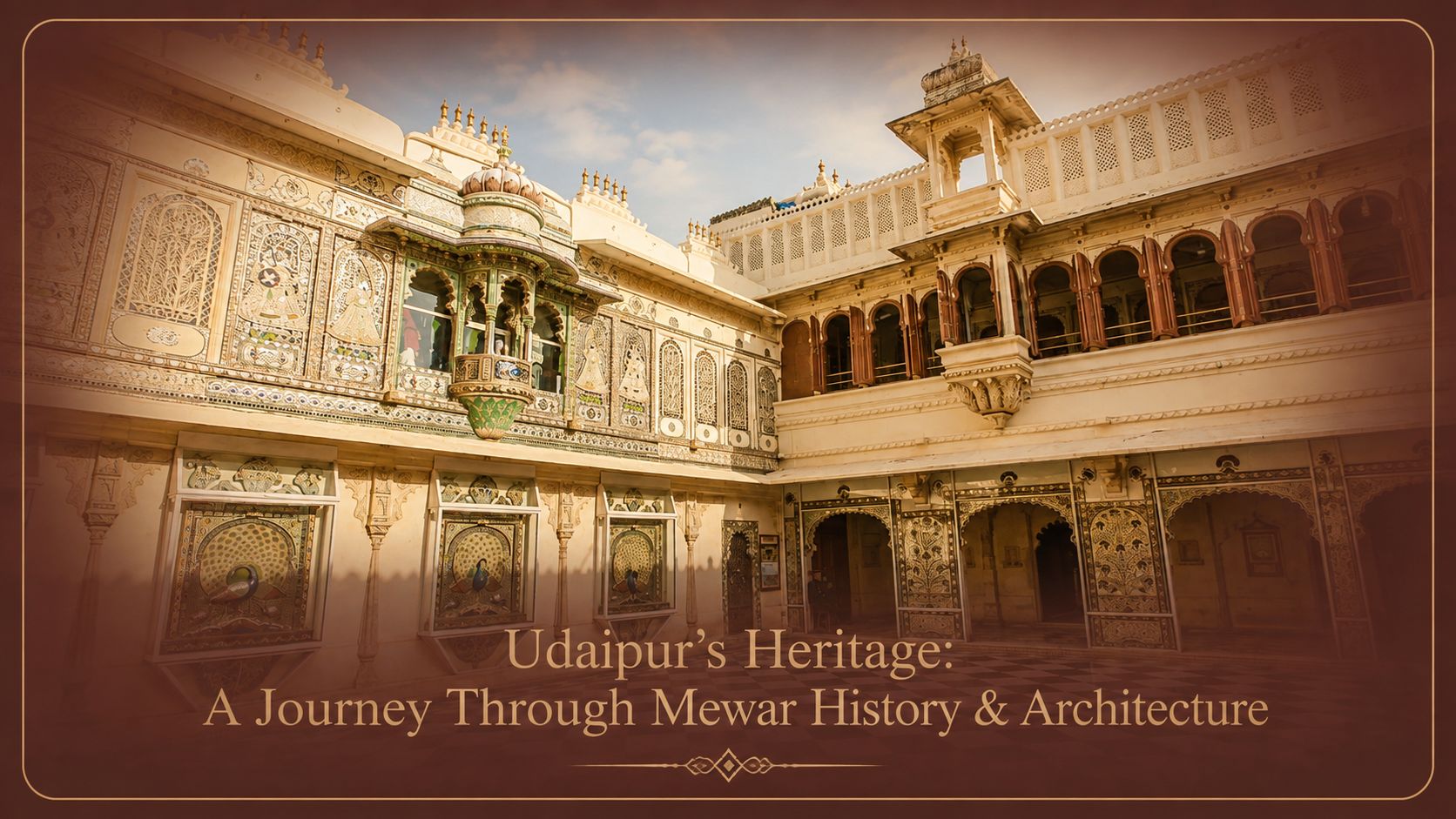

Udaipur's Heritage: A Journey Through Mewar History & Architecture
Udaipur's heritage is much more than its grand palaces. It is found in the architecture of the old city, historic havelis, temples, lakeside ghats, traditional courtyards, local crafts, food, and the centuries-old legacy of Mewar. From the City Palace overlooking Lake Pichola to the smaller streets and historic buildings around the old city, Udaipur offers travellers an opportunity to experience Rajasthan's history in a remarkably living form.
For first-time visitors, understanding this heritage can make a trip more meaningful. Instead of simply visiting one monument after another, you begin to see how Mewar's history, Rajput architecture, lakes, culture, and hospitality have shaped the city.
What Makes Udaipur a Heritage City?
Udaipur is considered an important heritage destination because of its connection with the history of Mewar and the remarkable collection of palaces, temples, havelis, gardens, ghats, and historic neighbourhoods found throughout the city.
The heritage of Udaipur is particularly distinctive because history and everyday life continue to exist alongside one another. A centuries-old architectural detail can be found only a short walk from a busy market, while historic waterfronts continue to be part of the city's daily rhythm.
The city's heritage can broadly be understood through five connected elements:
- Mewar's history and royal legacy
- Rajput and regional architectural traditions
- Palaces, havelis and historic residences
- Lakes, ghats and the surrounding landscape
- Living traditions, food, crafts and local culture
This combination is what gives Udaipur its distinctive character.

A Brief History of Udaipur and Mewar
To understand Udaipur's heritage, it helps to understand the story of Mewar.
Udaipur was founded in the 16th century by Maharana Udai Singh II, who established the city as a new capital of Mewar after the strategic challenges faced by Chittorgarh.
The location offered natural advantages. Surrounded by the Aravalli hills and built around a network of lakes, Udaipur developed into a city where landscape and architecture were closely connected.
Over generations, the rulers of Mewar expanded the city, creating palaces, gardens, temples, lakeside structures, and other architectural landmarks.
Maharana Pratap and the Legacy of Mewar
The history of Mewar is closely associated with Maharana Pratap, one of the most recognised figures in Rajasthan's history.
His resistance and association with the Battle of Haldighati have become an important part of the region's historical identity.
For visitors, this history provides context for understanding why Mewar's heritage places often emphasise ideas such as independence, honour, resilience, and Rajput traditions.
Udaipur as the Capital of Mewar
As the capital of Mewar, Udaipur developed a distinctive architectural and cultural identity.
Royal residences expanded into large palace complexes, while noble families and other residents built havelis and traditional homes around the city.
Over time, temples, markets, ghats, gardens, and neighbourhoods became part of the wider historic landscape.
This is why Udaipur's heritage cannot be understood by looking at a single palace alone. It is the relationship between these different elements that tells the larger story.

The Architecture of Udaipur
One of the most visible aspects of Udaipur's heritage is its architecture.
Traditional buildings often combine practical design with decorative details. Stone, plaster, carved surfaces, arches, balconies, courtyards, and jharokhas contribute to the visual character of historic Udaipur.
Rajput Architectural Influences
Rajput architecture can be seen in many of Udaipur's historic structures through features such as courtyards, elevated balconies, decorative windows, arches, stonework, and fortified or palace-like forms.
At the same time, Udaipur's architecture was not created in complete isolation. Different artistic and architectural influences developed over centuries, resulting in buildings that contain a mixture of regional traditions and influences.
Jharokhas, Courtyards and Traditional Details
Look closely at Udaipur's historic buildings and you will often notice details that are easy to miss when sightseeing quickly.
Jharokhas provide shaded openings and distinctive façades. Courtyards create open spaces within buildings, while carved stone and decorative surfaces add visual character.
These details are particularly noticeable in palaces and havelis, where architecture was designed not only for practical use but also to communicate status and aesthetics.
The Role of Lakes in Udaipur's Architecture
Udaipur's lakes are not simply scenic attractions placed next to the city.
They have played an important role in the city's development and visual identity.
Lake Pichola, Fateh Sagar Lake and other water bodies form an important part of the landscape around which palaces, ghats, gardens, and settlements developed.
This relationship between water, hills and architecture is one of the reasons Udaipur looks so different from many other historic cities in Rajasthan.
10 Heritage Places to Explore in Udaipur
If you want to understand Udaipur's heritage, these places provide a good starting point.

City Palace
The City Palace is arguably the most important heritage landmark in Udaipur.
Located beside Lake Pichola, the palace complex reflects centuries of development under the rulers of Mewar.
Its courtyards, balconies, corridors, decorative interiors, and elevated viewpoints offer an opportunity to see how royal architecture developed around the lake.
Don't rush through the complex. Look at the smaller architectural details as well as the famous views.

Lake Pichola
Lake Pichola is an essential part of Udaipur's heritage landscape.
Historic buildings, ghats, palaces and hills surround the lake, creating views that have become closely associated with the city.
A boat ride can offer a particularly interesting perspective because the relationship between the lake and the historic architecture becomes more obvious from the water.
Even if you don't take a boat ride, spending time around the lake at different times of the day can be rewarding.

Jagdish Temple
Located close to the City Palace, Jagdish Temple is one of Udaipur's most prominent historic temples.
Its detailed stone carvings and traditional architectural form make it an important stop for anyone interested in the city's religious and architectural heritage.
Because it is located in the old city, it can easily be included in a walking route that also covers other historic areas.

Bagore Ki Haveli
Bagore Ki Haveli provides a different perspective on Udaipur's heritage.
Unlike the enormous scale of a royal palace, a haveli offers insight into the residential architecture and lifestyle associated with historic noble families.
Its location near Lake Pichola also makes it convenient to combine with other attractions around the old city.

Sajjangarh (Monsoon Palace)
Sajjangarh, popularly known as the Monsoon Palace, sits on a hill overlooking Udaipur.
Its elevated position makes the surrounding Aravalli landscape an important part of the experience.
On a clear day, the views across the city and its lakes can be impressive. During the monsoon and post-monsoon period, the surrounding landscape can take on a greener appearance.

Saheliyon-ki-Bari
Saheliyon-ki-Bari is a historic garden known for its fountains, greenery and architectural details.
It offers a quieter contrast to the larger palace complexes and is useful for understanding another aspect of Udaipur's historic royal environment.

Jag Mandir
Located on an island in Lake Pichola, Jag Mandir is another important element of Udaipur's historic landscape.
The island palace demonstrates how water was incorporated into the city's royal architecture and leisure spaces.
Its position within the lake also makes it particularly interesting to view from a boat.

Ambrai Ghat
Ambrai Ghat is less about entering a historic building and more about experiencing Udaipur's heritage landscape.
From the waterfront, you can see Lake Pichola, the City Palace area and other historic structures from across the water.
Around sunset, the relationship between the lake and architecture becomes particularly striking.

Gangaur Ghat
Gangaur Ghat is another historic waterfront area in the old city.
Ghats have long been important spaces in cities built around rivers and lakes, serving cultural, religious and social purposes.
For visitors, Gangaur Ghat offers another opportunity to observe the relationship between Udaipur's historic neighbourhoods and its water bodies.

Ahar Cenotaphs
For travellers who want to explore beyond Udaipur's most famous attractions, the Ahar Cenotaphs are worth considering.
The site contains historic cenotaphs associated with the Mewar rulers and provides a quieter setting for appreciating traditional stone architecture.
It can be a useful addition to an itinerary for travellers who want to explore a less obvious side of Udaipur's heritage.
Udaipur's Heritage Havelis
Palaces may dominate photographs of Udaipur, but havelis are equally important to understanding the city's architectural character.
A traditional haveli was generally a large residence built around internal courtyards. Depending on its scale and purpose, it could include multiple rooms, balconies, decorative façades and spaces designed around the needs of the household.
What Makes a Haveli Different From a Palace?
The simplest distinction is scale and function.
A palace was associated with royal residence and administration, often incorporating large ceremonial spaces and extensive complexes.
A haveli was generally a private or noble residence, although some could be substantial and architecturally elaborate.
Both can contain courtyards, decorative stonework, balconies, arches and traditional design elements, but their historical functions were different.
Can You Stay in a Heritage Haveli in Udaipur?
Yes, some historic properties in and around Udaipur have been adapted into heritage accommodation.
For travellers, this creates an interesting opportunity: instead of simply looking at heritage architecture during sightseeing, you can experience elements of it as part of your stay.
The important thing is to look beyond the word "heritage" in a hotel's name and understand what the property actually offers in terms of architecture, atmosphere, location, comfort and hospitality.

Heritage Hotels in Udaipur: Staying Inside History
A heritage stay can add another layer to a Udaipur trip.
A conventional hotel can provide a comfortable base for sightseeing, but a heritage property can make the accommodation itself part of the destination experience.
You may notice traditional architectural details, courtyards, local design influences, historic materials, or a style of hospitality that feels more closely connected with Rajasthan.
For first-time visitors, this can be particularly appealing because the experience of the city doesn't necessarily end when you return from sightseeing.
Staying at Kaladwas Lal Haveli
For travellers interested in experiencing Udaipur through a heritage-oriented stay, Kaladwas Lal Haveli offers an opportunity to connect accommodation with the city's traditional character.
A property such as this can be particularly suitable for travellers who don't want their hotel to feel completely disconnected from the historic atmosphere they came to Udaipur to experience.
When choosing a heritage stay, however, consider the complete experience rather than architecture alone. Location, accessibility, room comfort, facilities, dining, and the type of trip you're planning should all influence your decision.
Udaipur's Heritage Beyond Palaces
One of the easiest mistakes first-time visitors make is assuming that Udaipur's heritage begins and ends with its palaces.
It doesn't.
Old City Streets
Walk away from the main attractions and you begin to see another side of Udaipur.
Traditional buildings, small shops, temples, balconies, painted façades and narrow lanes create an environment where historic architecture remains part of everyday life.
Traditional Markets
Udaipur's markets are another part of its living heritage.
Textiles, handicrafts, artwork, jewellery and decorative items reflect regional traditions and provide an opportunity to see how craftsmanship continues to contribute to the city's cultural identity.
Local Cuisine
Food is also part of heritage.
Traditional Rajasthani dishes such as dal baati churma, gatte ki sabzi and ker sangri are connected to the region's culinary traditions.
Trying local food can make a heritage-focused trip feel more complete.
Temples and Ghats
Historic temples and waterfront ghats continue to serve purposes beyond tourism.
They are places where religious practices, local routines and historic architecture overlap, making them particularly valuable for travellers who want to experience Udaipur as a living city rather than simply a collection of monuments.
How to Experience Udaipur's Heritage Like a Local
You don't need to visit every monument to understand Udaipur.
Sometimes, slowing down is more valuable than adding another attraction to your itinerary.
Explore the old city on foot
Walking allows you to notice architectural details that are easy to miss from a vehicle.
Visit major attractions earlier in the day
Starting early can give you more comfortable conditions and potentially a calmer experience at popular sites.
Spend time around the ghats
Don't just photograph the lake. Spend some time observing how the waterfront connects with the city.
Try local food
Choose traditional dishes where possible and explore beyond familiar tourist menus.
Look beyond the famous landmarks
Smaller havelis, temples, markets and neighbourhoods can provide some of the most interesting glimpses into Udaipur's living heritage.
Stay somewhere with local character
A heritage hotel or haveli can complement your sightseeing by making the accommodation itself part of your Udaipur experience.
Best Heritage Experiences in Udaipur
If you want to experience more than individual monuments, consider adding some of these activities to your itinerary:
- Explore the City Palace
- Walk through the old city
- Take a boat ride on Lake Pichola
- Visit historic havelis
- Explore traditional markets
- Try Rajasthani cuisine
- Watch the sunset around the historic waterfront
- Visit a heritage garden
- Attend a traditional cultural performance
- Stay at a heritage property
- Photograph traditional architecture and jharokhas
- Explore less-visited historic sites
The best heritage itinerary combines places, architecture and experiences rather than simply counting how many monuments you can visit.
How Many Days Do You Need to Explore Udaipur's Heritage?
For most travellers, two to three days provide a good starting point.
One Day
Focus on the City Palace, Jagdish Temple, Lake Pichola and the surrounding old city.
Two Days
Add Bagore Ki Haveli, Fateh Sagar Lake, a sunset experience and time to explore local markets.
Three Days
A third day allows you to slow down and include places such as Sajjangarh, Saheliyon-ki-Bari or Ahar, along with additional cultural and food experiences.
If heritage is the main reason for your trip, three days can be more rewarding than trying to complete everything in a single weekend.
Best Time to Explore Udaipur's Heritage
Udaipur can be explored throughout the year, but the experience changes considerably with the seasons.
If you're specifically interested in seasonal travel, see our guides to Udaipur in September and Udaipur in October for more practical information.
Summer
Temperatures can become very high, making long outdoor sightseeing less comfortable.
Monsoon
The surrounding landscape can become greener, while the lakes and hills take on a different character. Rain may require more flexible planning.
September and October
These months can offer a transition from monsoon conditions toward the drier travel season. The landscape may still retain some greenery while outdoor exploration becomes increasingly convenient.
Winter
The cooler months are generally popular for sightseeing and outdoor activities, although popular attractions can become busier.
Udaipur Heritage Travel Tips
A few simple tips can improve your experience.
Wear comfortable footwear.
Historic areas are often best explored on foot.
Start early.
Morning sightseeing can be more comfortable, particularly outside the cooler months.
Allow enough time at the City Palace.
It is much larger and more detailed than a quick visit might suggest.
Dress appropriately at temples.
Respect local customs and religious spaces.
Keep your itinerary flexible.
Weather, crowds and attraction timings can affect your plans.
Don't forget the smaller details.
Look at doors, windows, stone carvings, balconies and courtyards rather than focusing only on the biggest buildings.
Spend time by the water.
Udaipur's heritage is inseparable from its lakes and waterfronts.
Choose accommodation thoughtfully.
If heritage is central to your trip, staying at a property with local architectural character can enhance the experience.
Udaipur Heritage at a Glance
Palaces
City Palace, Jag Mandir
Havelis
Bagore Ki Haveli and traditional heritage properties
Temples
Jagdish Temple and historic shrines
Lakes & Ghats
Lake Pichola, Gangaur Ghat, Ambrai Ghat
Architecture
Jharokhas, courtyards, arches and stonework
Culture
Food, crafts, performances and festivals
History
Mewar's royal legacy
Accommodation
Heritage hotels and havelis
Frequently Asked Questions About Udaipur Heritage


What Makes Udaipur's Heritage Special?
Udaipur's heritage is not limited to a collection of impressive old buildings.
It is the relationship between Mewar history, Rajput architecture, palaces, havelis, temples, lakes, ghats, local traditions and everyday life that gives the city its identity.
You can spend the morning exploring a royal palace, walk through an old neighbourhood in the afternoon, watch the evening light over Lake Pichola, enjoy a traditional meal, and return to a heritage property at night.
That continuity is what makes experiencing Udaipur's heritage different from simply visiting historic monuments.
For travellers who want to connect more closely with the city's traditional character, choosing a heritage-oriented stay such as Kaladwas Lal Haveli can make accommodation part of the journey rather than just a place to sleep.
Udaipur's heritage is ultimately best understood slowly—one palace, haveli, lake, street and local experience at a time.

