

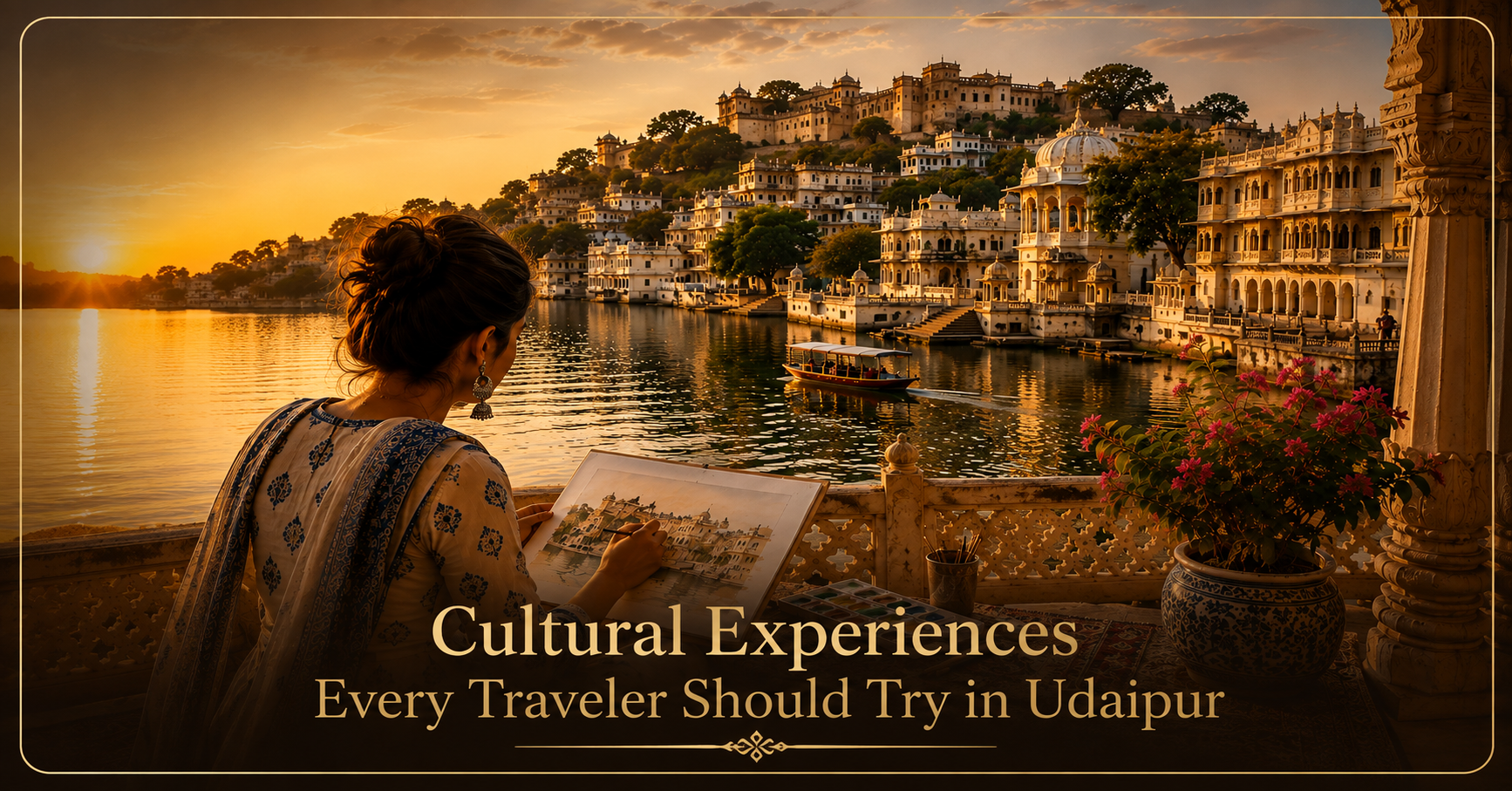

Every Traveler Should Try in Udaipur
Udaipur is easier to understand when you experience more than its palaces and lakes. A visit becomes richer when you spend time listening to Rajasthani folk music, watching traditional dance, exploring Mewar's royal collections, walking through the Old City, seeing local crafts being made, tasting Mewari food, and slowing down enough to notice how heritage still shapes everyday life.
For a first-time traveller, the best cultural experiences in Udaipur are not necessarily the ones that take the longest. A City Palace visit, an evening folk performance, a walk through the old markets, a visit to Shilpgram, a traditional meal, and time inside a heritage haveli can give you a much better sense of the city's character than simply ticking off monuments.
What Are the Best Cultural Experiences in Udaipur?
If you have limited time, prioritise these experiences:
These experiences cover different sides of Udaipur's culture: royal history, performing arts, architecture, food, craftsmanship, religion and everyday Old City life.
Explore the City Palace Museum and its Mewar collections.
Watch the Dharohar cultural dance show at Bagore Ki Haveli.
Walk through the Old City's historic lanes and markets.
Visit Shilpgram to understand Rajasthan's rural arts and crafts traditions.
Experience Rajasthani folk music and dance in an intimate setting.
Try traditional Mewari cuisine rather than eating only familiar restaurant dishes.
Visit Jagdish Temple respectfully and observe its architecture and religious atmosphere.
Explore Rajasthani handicrafts and textiles in local markets.
Take a heritage walk instead of seeing the Old City only from a vehicle.
Stay in a heritage haveli where architecture, food and local experiences become part of the trip.

Explore the City Palace Through the History of Mewar
The City Palace is an obvious stop in Udaipur, but it becomes much more meaningful when you visit it as a cultural experience rather than simply photographing its courtyards.
The City Palace Museum occupies part of the historic palace complex associated with the former rulers of Mewar. The museum's collections include paintings, textiles, sculptures, silver objects, photographs, maps, palanquins and other material connected with the region's royal history.
Look closely at the details rather than rushing from room to room.
The Mewar paintings, glass and mirror work, textiles, ceremonial objects and architectural features tell you something about how court life, religion, art and craftsmanship were connected.
How to make the experience better
Give yourself enough time to actually read the displays. If you are interested in history or art, an audio guide can also add context; the museum currently lists audio guides in English, French, German and Spanish among its visitor facilities.

Watch a Traditional Folk Performance at Bagore Ki Haveli
If you want to see Rajasthan's performing arts rather than simply read about them, spend an evening at Bagore Ki Haveli.
Located at Gangaur Ghat beside Lake Pichola, the 18th-century haveli is itself an important piece of Udaipur's heritage. Rajasthan Tourism highlights the Dharohar dance show at Neem Chowk as a cultural experience featuring music and traditional performances.
This is one of those experiences that works particularly well after a day of sightseeing.
Instead of ending the evening with another monument, you sit down and watch Rajasthan's folk traditions presented through movement, music and performance.
What to expect
Depending on the programme, traditional performances can include folk dance, music and puppetry traditions associated with Rajasthan.
The setting adds to the experience. The performance takes place within a historic haveli environment rather than a modern theatre.

Walk Through Udaipur's Old City Instead of Just Driving Through It
One of the easiest cultural experiences to overlook is simply walking.
Udaipur's Old City is where architecture, commerce, temples, small workshops, food stalls and everyday life overlap. Streets around areas such as Jagdish Chowk, Ghanta Ghar and the lakefront can feel very different from the city's larger roads.
You notice things from the ground that disappear when you travel by car:
- old wooden doors
- carved façades
- small shrines
- traditional shopfronts
- craftsmen at work
- local snack stalls
- textiles and handicrafts
- balconies and painted details
The Rajasthan Tourism Department also identifies markets such as Hathi Pole, Jagdish Chowk and Ghanta Ghar as places to explore traditional handicrafts, jewellery, clothes and other local products.
The better approach
Don't try to cover every lane.
Choose a small area and walk slowly for an hour or two. Stop when something catches your attention. That is often more rewarding than following a rigid checklist.

Visit Shilpgram to See Rajasthan's Craft Traditions in Context
For travellers interested in crafts, Shilpgram offers a different perspective from shopping in a market.
The West Zone Cultural Centre describes Shilpgram as a rural arts and crafts complex and a living ethnographic museum representing the architecture and lifestyles of folk and tribal communities of western India. Its traditional huts represent different regional cultures and display household objects, textiles, terracotta, woodwork, metalwork and tools.
That context matters.
Buying a handmade object tells you what something looks like. Seeing the traditional environment in which crafts, tools and household objects are presented gives you a better understanding of why those objects exist and how they relate to everyday life.
Best time to visit
Allow enough time to walk around rather than treating Shilpgram as a quick photo stop.
The centre also hosts cultural programmes, including the annual Shilpgram Utsav, which brings together artisans, craftspeople and performing artists.

Taste Mewari Cuisine, Not Just "Rajasthani Food"
Food is one of the easiest ways to experience culture without turning your itinerary into a museum tour.
Udaipur's culinary traditions are part of the wider food culture of Mewar. Instead of ordering only dishes you already recognise, ask the restaurant what local preparations are available.
Look for traditional flavours and dishes such as:
- Dal Baati Churma
- Gatte ki Sabzi
- Ker Sangri
- Bajra-based preparations
- traditional Rajasthani breads
- seasonal local vegetables
- traditional sweets
The important part is not simply trying a famous dish. Ask about how it is prepared and why particular ingredients are common in Rajasthan.
The dry climate and availability of ingredients have historically influenced Rajasthani cooking, resulting in techniques and recipes that make practical use of grains, pulses, dried vegetables, spices and dairy.
A more interesting food experience
If your hotel offers a culinary session or traditional meal, consider choosing that over a standard buffet. A smaller experience where someone explains the ingredients and preparation can tell you much more about local food culture.

Experience Rajasthani Folk Music in an Intimate Setting
You don't always need a major performance to experience Rajasthan's musical traditions.
Folk music works particularly well in smaller settings where the performance is close to the audience and the evening is not rushed.
This is also where a heritage stay can add something to your trip.
At Kaladwas Lal Haveli, the property's official website describes curated cultural experiences that include folk music evenings, heritage walks through Udaipur's Old City and local interactions. It also describes rooftop dining accompanied by folk music.
That creates a useful alternative for travellers who don't want every cultural experience to involve travelling to another attraction.
After a day exploring Udaipur, you can return to the atmosphere of a heritage haveli and experience music as part of the evening.

Step Inside a Heritage Haveli
Udaipur's culture is not preserved only inside museums.
Some of it survives in the city's havelis, courtyards, balconies, wooden details, traditional rooms and restored residences.
Staying in a heritage property gives you a different way of experiencing architecture because you spend several hours inside it rather than visiting for thirty minutes with a camera.
Why a heritage stay feels different
You start noticing smaller details:
- how courtyards are arranged
- how rooms connect
- traditional decorative elements
- carved woodwork
- old architectural proportions
- local materials
- the relationship between private and shared spaces
For travellers interested in this side of Udaipur, Kaladwas Lal Haveli is particularly relevant.
The property describes itself as a restored 300-year-old heritage haveli-turned-boutique hotel in Udaipur's Old City, with its architecture and interiors designed around Mewar's heritage and traditional Rajasthani craftsmanship.
That makes the accommodation itself part of the cultural itinerary rather than simply somewhere to sleep.

Visit Jagdish Temple and Observe Living Heritage
Jagdish Temple is not simply another architectural landmark to photograph.
Rajasthan Tourism identifies it as a prominent temple in Udaipur, built in 1651 and dedicated to Lord Vishnu, with carved pillars, ceilings and painted walls.
The cultural experience comes from observing the temple as a living place of worship.
Take time to appreciate the stone carving and architectural details, but also remember that this is an active religious space.
A few practical etiquette points
- Dress respectfully.
- Follow instructions from temple staff.
- Avoid photographing people during private moments or rituals without permission.
- Keep your voice low.
- Observe local customs rather than treating the temple only as a tourist attraction.
This is a small adjustment, but it changes how you experience the place.

Shop for Crafts With a Story Behind Them
Shopping becomes more meaningful when you know what you are buying.
Udaipur's markets offer a range of traditional products, including textiles, handicrafts, jewellery, paintings and decorative objects. Rajasthan Tourism specifically highlights Hathi Pole, Jagdish Chowk and Ghanta Ghar among the city's shopping areas.
Instead of buying the first colourful souvenir you see, take a few minutes to ask:
Who made this? What material is it? Is it handmade? Where does this style come from?
You may not always get a detailed answer, but the question itself changes the shopping experience.
Good things to look for
- miniature-style paintings
- textiles
- block-printed fabrics
- handmade decorative pieces
- traditional jewellery
- locally crafted objects
If you are buying something fragile, consider how you will carry it home before purchasing.

Take a Heritage Walk Through Udaipur
A heritage walk is one of the best ways to connect separate pieces of Udaipur's history.
A palace tells you about royalty.
A temple tells you about faith.
A market tells you about commerce.
A haveli tells you about domestic architecture.
A heritage walk puts these pieces together.
A good walk through the Old City can connect landmarks such as Jagdish Temple, Gangaur Ghat, Ghanta Ghar and historic haveli neighbourhoods while explaining how they relate to one another.
For a first-time visitor, this is particularly useful because Udaipur can initially feel like a collection of separate attractions. Walking between them reveals the city as a living urban fabric.

Watch the City Change Around Lake Pichola
Lake Pichola is usually presented as a scenic attraction, but it also helps explain why Udaipur developed the way it did.
The lake is closely connected to the city's palaces, ghats, old neighbourhoods and visual identity. Rajasthan Tourism describes Udaipur as a city shaped by its lakes and the surrounding Aravalli landscape.
Instead of making the lake only a photography stop, spend some time observing the waterfront.
Try a simple sequence:
- Late afternoon: Walk around the Old City.
- Sunset: Find a quiet viewpoint or take a boat ride if appropriate.
- After sunset: Watch the palaces, ghats and buildings begin to illuminate.
The experience is less about checking off another attraction and more about understanding the relationship between water, architecture and city life.

Learn About Mewar Through Art and Paintings
If you have an interest in Indian art, spend time with the painting collections at the City Palace Museum.
The museum's galleries include works connected with the Mewar school of painting, with subjects ranging from royal processions and celebrations to religious places, hunting scenes and court life.
This provides a useful cultural connection between what you see around Udaipur and what you find inside its museums.
Look at the paintings slowly.
Notice clothing, architecture, animals, processions, landscapes and colours. These details can reveal aspects of historic life that a conventional history label might not explain.
For travellers interested in visual storytelling, this can become one of the most rewarding parts of a City Palace visit.

Experience Udaipur During a Festival
If your dates coincide with a local festival, make room for it.
Festivals can show a side of Udaipur that regular sightseeing cannot reproduce.
The Mewar Festival, for example, is associated with the arrival of spring and is celebrated in Udaipur with cultural activity, decorated markets and traditional celebrations. Rajasthan Tourism notes its connection with the Gangaur festival and its particular significance for women in Rajasthan.
Festival travel requires a little more planning, though.
Accommodation can become busier, roads and public areas may be crowded, and programmes can change. Check current official information before planning your day around a specific event.
Udaipur's Culture Without Rushing
You don't need to visit every museum and cultural attraction.
A better approach is to combine one major heritage site, one performance, one food experience and one local activity each day.
If you have one day
Morning: City Palace Museum
Afternoon: Old City walk + local market
Evening: Dharohar performance at Bagore Ki Haveli
Dinner: Traditional Mewari/Rajasthani meal
If you have two days
Add:
Shilpgram
Jagdish Temple
Lake Pichola experience
heritage walk
local craft shopping
If you have three days
Slow the itinerary down.
Add a heritage stay experience, a culinary session, more time in the Old City and a less-visited cultural attraction such as Bharatiya Lok Kala Mandal.
Rajasthan Tourism describes Bharatiya Lok Kala Mandal as an institution dedicated to folk art, culture, songs and festivals of Rajasthan, Gujarat and Madhya Pradesh, with a museum of Rajasthani cultural artefacts.
The third day is where you can stop trying to "see everything" and actually spend time with the city.


For a More Immersive Cultural Experience
Your accommodation can influence how much of Udaipur's culture you experience.
Staying near the Old City makes it easier to walk to historic areas, markets, temples and lakefront neighbourhoods rather than treating each cultural experience as a separate excursion.
For travellers who want accommodation to contribute to the cultural experience, Kaladwas Lal Haveli offers a heritage-focused option in the Old City.
The property describes itself as a restored 300-year-old haveli with traditional Rajasthani architecture, Mewar-inspired interiors and themed rooms based on aspects of Udaipur's history and heritage. Its website also highlights folk music evenings, heritage walks, local interactions, traditional Mewari cuisine and rooftop dining with live folk performance.
The advantage is simple: your cultural experience does not have to stop when sightseeing ends.
You can spend the day exploring Udaipur and return to a setting that continues the same heritage story through architecture, food and music.
For Experiencing Udaipur's Culture Respectfully
Dress appropriately at religious sites
Light, comfortable clothing is practical for Udaipur, but temples and other religious spaces may require more conservative dress.
Ask before photographing people
A good photograph is never more important than someone's privacy.
Don't bargain aggressively
Negotiating is common in many markets, but there is a difference between reasonable bargaining and making a purchase uncomfortable for a small artisan or shopkeeper.
Give yourself unplanned time
Some of the best cultural moments happen between attractions—a conversation with a shopkeeper, an old doorway, a street musician or a small workshop.
Check current timings
Museum hours, performances, festivals and visitor arrangements can change. Verify current information before travelling.
Choose experiences over checklists
If you spend two hours genuinely exploring one neighbourhood, you may remember it more clearly than six attractions visited in a hurry.
Everything You Need to Know
Experience Udaipur Beyond the Postcard
Udaipur's culture is not confined to the City Palace or a museum display.
It is in the sound of folk music after sunset, the details carved into an old doorway, the food served at a family table, the crafts displayed in a market, the rituals at a temple and the stories behind the paintings of Mewar.
That is why the most rewarding Udaipur itinerary leaves some space between the major attractions.
Visit the palace. Then walk.
Watch the dance. Then stay for dinner.
Buy a craft. Ask about the person who made it.
Stay in a heritage haveli. Notice the architecture around you.
The goal is not to collect cultural experiences as a checklist. It is to leave Udaipur understanding a little more about Mewar, its people, its artistic traditions and the living heritage of the Old City.

