

Reception: +91-830 290 2727
Office: +91-830 290 2727
E-mail: kaladwaslalhaveli@gmail.com
Address: 96, Chawra House Ganesh Ghati Udaipur, Rajasthan 313001
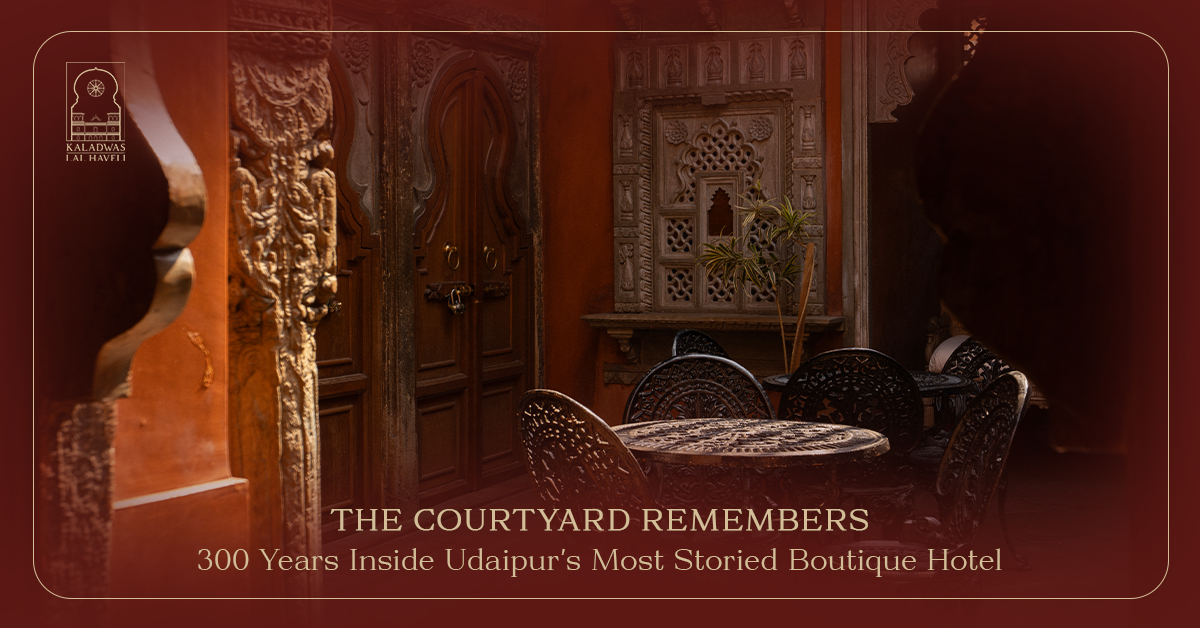
The Courtyard Remembers: 300 Years Inside Udaipur’s Most Storied Boutique Hotel
“If walls could speak, they would tell us who we once were. But sometimes, it is the courtyard that remembers best.”
Long before maps guided travelers with blue dots and luxury became synonymous with polished marble lobbies, journeys were measured differently. People remembered not the thread count of their bedding or the size of a swimming pool, but the warmth of the welcome they received, the stories exchanged beneath open skies, and the homes that embraced strangers as honored guests.
Across Rajasthan, these stories still linger.
They live within weathered sandstone walls, beneath gracefully carved arches, inside quiet corridors where footsteps have echoed for centuries, and most of all, in the courtyards of old havelis—the heart of homes that have witnessed generations of celebrations, farewells, festivals, and everyday life.
A courtyard has no voice, yet it remembers everything.
It remembers children chasing each other beneath the afternoon sun. It remembers musicians filling cool evenings with the melodies of the sarangi. It remembers royal processions passing through narrow streets, merchants returning from distant trade routes, families gathering beneath monsoon skies, and travelers arriving weary after long journeys, only to be welcomed with folded hands and genuine warmth.
Unlike monuments preserved behind ropes and signboards, heritage havelis continue to breathe. Their stories are not frozen in history books; they unfold quietly with every guest who walks through their ancient gateways.
Today, as travelers seek experiences rooted in authenticity rather than extravagance, these historic residences have found a renewed purpose. Thoughtfully restored as Heritage Boutique Hotels in Udaipur, they invite visitors to experience history not as spectators, but as participants in an ongoing story that has unfolded over centuries.
Where a Courtyard Becomes the Keeper of Time
In traditional Rajasthani architecture, the courtyard was never simply an open space at the center of a house.
It was where life happened.
Families gathered here each morning before the day began. Children learned their first steps across cool stone floors. Elders shared stories that connected one generation to the next. Festivals filled the air with music, laughter, and the fragrance of marigolds, while evenings brought quiet conversations beneath a sky illuminated by stars.
The courtyard was both practical and symbolic.
Architecturally, it welcomed natural light, encouraged ventilation, and created comfort during Rajasthan’s demanding summers. Socially, it became the heart of family life—a place where traditions were practiced rather than preserved.
Centuries later, these same courtyards continue to serve a similar purpose.
Guests pause here over morning tea, photographers wait patiently for the perfect play of sunlight through carved arches, and travelers often find themselves lingering longer than expected, captivated by an atmosphere that cannot be designed or manufactured.
It is this enduring sense of place that distinguishes a Heritage Stay in Udaipur from a conventional hotel experience.
The courtyard does not simply decorate the building.
It gives the building its soul.
The Legacy of Rajasthani Havelis
Every city has buildings that define its skyline.
In Rajasthan, it is the haveli that defines its cultural identity.
Long before modern hotels emerged, havelis served as private residences for noble families, merchants, landowners, and distinguished members of society. Built with remarkable craftsmanship and an understanding of both climate and community, these homes reflected not only prosperity but also values deeply rooted in hospitality, artistry, and family life.
Unlike palaces designed to impress kingdoms, havelis were designed to nurture everyday living.
Their architecture balanced grandeur with intimacy.
Elegant courtyards welcomed sunlight into the home, shaded verandas softened the desert heat, intricately carved jharokhas framed changing views of the surrounding streets, and decorative facades transformed stone into storytelling.
Every architectural detail had purpose.
Thick walls maintained comfortable interiors throughout the changing seasons. Elevated balconies allowed women of the household to observe festivals and processions while preserving privacy. Handcrafted wooden doors reflected the artistry of local craftsmen, while painted frescoes documented mythology, regional folklore, and moments from daily life.
These were not decorative additions.
They were expressions of Rajasthan’s cultural identity.
Today, many of these remarkable buildings continue to stand—not merely as architectural achievements but as living reminders of a way of life shaped by craftsmanship, community, and tradition.
More Than Buildings, They Preserve a Civilization
To admire a heritage haveli solely for its architecture is to see only half its story.
The true significance of these buildings lies in what they preserve beyond stone and timber.
They safeguard memories.
Every restored Heritage Haveli carries within its walls the imprint of countless human experiences—celebrations, conversations, artistic traditions, family rituals, and acts of hospitality that have quietly shaped generations.
Walk through a centuries-old doorway, and you are stepping into spaces where lives unfolded long before yours.
A carved window may have framed the same sunrise for three hundred years.
A courtyard may have witnessed hundreds of festive gatherings.
A stone staircase may have carried generations from one chapter of life to the next.
Unlike modern architecture, which often prioritizes efficiency, heritage buildings reveal how people once lived, interacted, and understood beauty.
They remind us that architecture is not merely about construction.
It is about culture made visible.
Why Modern Travelers Are Drawn to Heritage Stays
The way people travel has changed dramatically.
For decades, luxury was measured by scale—larger resorts, grander entrances, and increasingly elaborate facilities.
Today’s travelers, however, often seek something less tangible but far more meaningful.
They seek authenticity.
Rather than asking how luxurious a property appears, they ask questions such as:
- Does this place have a story?
- Will I experience local culture?
- Can I connect with the destination beyond its landmarks?
- Will I remember this stay years from now?
These questions explain why the appeal of the Boutique Hotel in Udaipur continues to grow among discerning travelers.
Unlike standardized accommodations designed for consistency, boutique heritage properties celebrate individuality.
No two rooms are identical.
No corridor follows an identical blueprint.
Every carved doorway, antique ceiling, fresco, courtyard, and terrace reflects the personality of the building itself.
For many visitors, this individuality becomes the defining memory of their journey.
Luxury is no longer found only in opulence.
It is found in authenticity.
The Difference Between Visiting History and Living Inside It
Most journeys through history are brief.
We purchase a ticket, admire centuries-old architecture, capture photographs, and move on to the next attraction.
A Historic Haveli Stay offers something profoundly different.
Instead of observing history from a distance, guests become part of it.
Morning begins beneath timber ceilings handcrafted generations ago.
Sunlight filters through original jharokhas, casting intricate patterns across stone floors that have welcomed countless footsteps over centuries.
Breakfast unfolds in a courtyard where families once gathered long before tourism existed.
Evenings end on rooftops where changing skies have been admired for hundreds of years.
History becomes part of ordinary life.
The building is no longer something to look at.
It becomes something to live within.
This emotional connection cannot be replicated by museums or monuments alone.
It emerges only when architecture continues to serve its original purpose—as a place where people gather, rest, celebrate, and create new memories.
A New Chapter for Timeless Homes
Across Rajasthan, many heritage residences have found a renewed role in the modern world.
Rather than allowing these remarkable buildings to fade into history, careful restoration has transformed them into intimate Heritage Boutique Hotels in Udaipur, where architectural conservation and contemporary comfort exist in harmony.
The objective is never to modernize history.
Instead, it is to preserve its character while ensuring that future generations can continue to experience it.
Original courtyards remain the heart of the property.
Traditional arches continue to frame the light.
Handcrafted stonework, antique wooden doors, frescoes, and decorative details are restored with remarkable care, allowing every architectural element to retain its historical integrity.
Modern comforts are thoughtfully integrated, not imposed.
The result is a hospitality experience that respects the past without asking guests to compromise on the expectations of the present.
The Courtyard Still Welcomes New Stories
Among the heritage homes that continue to preserve this remarkable legacy, Kaladwas Lal Haveli stands as a quiet reminder that history is not confined to museums or monuments.
For nearly 300 years, this beautifully preserved Heritage Boutique Hotel in Udaipur has witnessed the changing rhythm of the city while retaining the timeless character of traditional Mewari architecture.
Its courtyard remains the heart of the haveli, surrounded by graceful arches, handcrafted stonework, heritage-inspired interiors, and architectural details shaped by generations of artisans. Though centuries have passed, the essence of hospitality remains unchanged. Guests are welcomed not as fleeting visitors but as participants in a story that continues to unfold with every arrival.
Here, the past is not recreated—it is lived. The building’s enduring architecture, personalized hospitality, and thoughtfully integrated modern comforts allow travelers to experience the elegance of a Haveli Stay in Udaipur in a way that feels authentic rather than curated.
Every sunrise across the courtyard, every quiet conversation beneath its open sky, and every shared meal becomes another chapter added to a legacy that has been unfolding for three centuries.
As travelers increasingly seek meaningful journeys over predictable luxury, places like Kaladwas Lal Haveli remind us that the finest stories are not always found in guidebooks. Sometimes, they are waiting patiently in a courtyard that has never forgotten
Traditional Mewari Architecture: Where Every Stone Tells a Story
Architecture is often described as frozen history.
In Rajasthan, however, it feels remarkably alive.
The great havelis of Mewar were never designed simply to impress. They were conceived as homes that responded to climate, celebrated craftsmanship, nurtured family life, and reflected the artistic sensibilities of their time. Every arch, courtyard, carved balcony, and painted wall served a purpose that was both practical and deeply symbolic.
Unlike contemporary buildings, where form often follows efficiency, traditional Mewari architecture followed a different philosophy: a home should breathe with the seasons, adapt to its surroundings, and become richer with every passing generation.
This is why a Heritage Boutique Hotel in Udaipur offers something beyond visual beauty. It invites travelers to experience architectural wisdom that has endured for centuries—an approach to design where elegance and functionality exist in perfect harmony.
The Courtyard: The Living Heart of a Heritage Haveli
Every traditional Rajasthani Haveli begins with its courtyard.
While visitors often admire ornate façades or intricately carved balconies, it is the open courtyard that quietly shapes the experience of the entire home. It is both the architectural and emotional center—a place where sunlight, fresh air, and everyday life naturally converge.
For centuries, the courtyard served many roles.
It welcomed the first light of dawn, provided respite during the afternoon heat, and became the gathering place where generations shared meals, celebrations, music, and conversation. Weddings, festivals, family milestones, and quiet evenings all unfolded within this open space, making it the silent witness to countless moments of joy.
Its design was equally practical.
Surrounded by rooms on all sides, the courtyard created natural ventilation, allowing cool air to circulate while drawing warm air upward. Long before air conditioning existed, this thoughtful planning made homes comfortable even during Rajasthan’s intense summers.
Today, guests staying in a Heritage Stay in Udaipur continue to experience this timeless rhythm. Morning tea tastes different beneath an open sky framed by centuries-old arches. Sunlight shifts gently across stone floors throughout the day, and evenings settle into a calm that invites conversation rather than distraction.
The courtyard does not ask for attention.
It simply creates an atmosphere where time slows down.
Jharokhas: Windows That Framed Both Views and Stories
Few architectural features are as closely associated with Rajasthan as the jharokha.
Projecting gracefully from upper floors, these beautifully carved balconies are instantly recognizable, yet their significance extends far beyond aesthetics.
Historically, jharokhas allowed members of royal and noble households to observe life outside while maintaining privacy. From these elevated spaces, festivals, processions, marketplaces, and changing seasons became part of everyday life.
Architecturally, they also served an important environmental purpose.
Their overhanging design shaded windows from direct sunlight while encouraging natural airflow—an elegant solution perfectly suited to Rajasthan’s climate.
Today, they continue to define the character of many Heritage Hotels in Udaipur.
Standing beside a centuries-old jharokha, travelers often find themselves pausing—not only to admire the craftsmanship but to imagine the countless lives that once looked through the very same window.
Every carved edge carries the quiet memory of changing generations.
Arches That Welcome Rather Than Separate
Walk through a traditional haveli and one architectural element appears again and again: the arch.
Far more than structural supports, arches create rhythm within the building. They guide movement gently from one space to another, framing courtyards, corridors, and terraces with graceful proportions.
In Mewari architecture, arches soften transitions. Instead of abrupt divisions between rooms, they encourage a natural flow, allowing each space to feel connected while retaining its own identity.
Their decorative details often reveal the remarkable skill of local artisans. Floral motifs, geometric patterns, and delicate carvings transform stone into sculpture, demonstrating that even functional elements were approached as works of art.
For guests, these arches create an experience that feels almost cinematic. Each doorway frames another view—a courtyard bathed in morning light, a quiet staircase, or a rooftop opening toward the Aravalli Hills—inviting exploration rather than simply directing movement.
Stone That Carries the Memory of Generations
In Rajasthan, stone is more than a building material.
It is a storyteller.
Local sandstone and marble have shaped the region’s architecture for centuries, valued not only for their durability but also for their natural beauty and ability to respond to the climate. Thick stone walls absorb heat during the day and release it slowly after sunset, helping maintain comfortable indoor temperatures without mechanical intervention.
This understanding of climate-responsive design reflects an architectural intelligence that remains relevant even today.
Yet what makes these walls extraordinary is not simply their function.
Look closely and subtle signs of time become visible.
The smoothness of a staircase polished by countless footsteps.
The gentle weathering of carved pillars.
The soft variations in stone that reveal decades of changing seasons.
Unlike modern buildings that strive to appear untouched, heritage architecture embraces the beauty of age. These marks are not imperfections—they are evidence of life, continuity, and endurance.
Frescoes: Stories Painted on Walls
Before photographs documented everyday life, walls often became canvases for memory.
Across Rajasthan, many heritage havelis feature hand-painted frescoes depicting mythological tales, floral patterns, royal processions, and scenes from daily life. These paintings transformed interiors into visual narratives, preserving artistic traditions while reflecting the cultural values of their time.
Each fresco was created by skilled artisans using natural pigments and painstaking techniques that required extraordinary patience.
Unlike mass-produced décor, no two murals were ever truly identical.
Even when time has softened their colors, these paintings retain a quiet elegance. Their faded hues remind us that beauty does not diminish with age—it evolves.
For travelers, these frescoes offer something more meaningful than decoration. They provide glimpses into the imagination, beliefs, and artistic expression of generations who shaped Rajasthan’s cultural identity.
Handcrafted Wooden Doors: The First Welcome
Every memorable journey begins with an entrance.
In traditional Mewari havelis, handcrafted wooden doors were designed to make that first impression unforgettable. Crafted from durable hardwoods and adorned with intricate carvings, brass fittings, and decorative motifs, these entrances reflected both the prosperity of the household and the artistry of local craftsmen.
Yet they were never created merely for display.
Massive wooden doors provided security, insulation, and protection from the harsh climate while serving as symbolic thresholds between the outside world and the warmth of home.
Passing through one of these ancient entrances today carries a quiet emotional resonance. It is easy to imagine the generations of guests, family members, merchants, and travelers who crossed the same threshold over hundreds of years.
Every doorway becomes an invitation to step into another era.
Traditional Craftsmanship: Preserving Skills That Define Rajasthan
The enduring beauty of a Heritage Haveli is the result of countless hands working with remarkable precision and patience.
Behind every carved balcony, painted ceiling, and stone column stand artisans whose techniques have been passed from one generation to the next.
Traditional craftsmanship remains one of Rajasthan’s greatest cultural treasures.
It lives in:
Stone Carving
Intricately carved façades, pillars, brackets, and decorative panels demonstrate extraordinary skill while celebrating the natural beauty of local stone.
Woodworking
Handcrafted doors, antique furniture, ceiling beams, and ornamental details continue to reflect centuries-old woodworking traditions.
Fresco Painting
Natural pigments, intricate brushwork, and storytelling through art preserve cultural narratives that remain deeply connected to Rajasthan’s heritage.
Metalwork and Decorative Arts
Brass fixtures, traditional lanterns, handcrafted locks, and decorative accents contribute subtle yet meaningful layers of authenticity throughout heritage interiors.
By choosing a Boutique Heritage Hotel, travelers indirectly support the preservation of these traditional skills, ensuring they remain valued in an increasingly modern world.
Restoring Heritage Without Losing Its Soul
Preserving a historic haveli is an exercise in balance.
A building that has stood for centuries cannot simply remain untouched. Time inevitably brings structural wear, changing expectations, and the need for thoughtful adaptation. Yet restoration is not about replacing the old with the new—it is about protecting the building’s identity while ensuring it continues to serve future generations.
This philosophy defines the finest Luxury Heritage Hotels.
Original architectural features are carefully repaired rather than removed. Historic courtyards remain open to the sky. Traditional materials are used wherever possible, and modern amenities are integrated discreetly so that comfort enhances the experience without overwhelming the building’s character.
The objective is simple:
To allow guests to enjoy the convenience of the present while remaining immersed in the authenticity of the past.
Kaladwas Lal Haveli: A Living Expression of Mewari Architecture
Among the heritage residences that continue to preserve Rajasthan’s architectural legacy, Kaladwas Lal Haveli offers a remarkable example of how thoughtful conservation can breathe new life into a historic home.
For nearly 300 years, the haveli has stood as a testament to Traditional Mewari Architecture, where graceful arches, intricately carved stonework, heritage courtyards, handcrafted wooden details, and timeless design principles continue to define its identity. Rather than reconstructing history, its restoration has respected the craftsmanship and proportions that have shaped the building for generations.
Walking through the haveli today, guests encounter spaces where architecture feels lived in rather than staged. Sunlight filtering through traditional openings, cool stone beneath their feet, heritage-inspired interiors, and intimate gathering spaces create an atmosphere that reflects the rhythm of a true Heritage Boutique Hotel in Udaipur.
Modern comforts have been incorporated with restraint, allowing the building’s original character to remain the focal point. The result is not simply a luxurious place to stay, but an opportunity to experience centuries of architectural wisdom in a setting that continues to evolve without losing its soul.
It is a reminder that the greatest heritage buildings are never defined solely by their age. They are defined by their ability to remain relevant, welcoming, and deeply connected to the traditions that first brought them to life.
Hospitality Through the Centuries: The Tradition That Never Changed
Buildings may survive through stone, timber, and craftsmanship, but heritage endures because of people.
A haveli without its stories is simply architecture. Its arches, courtyards, and carved balconies become truly meaningful only when they continue to welcome laughter, conversation, celebration, and quiet reflection. Over three centuries, countless lives have crossed the thresholds of Rajasthan’s heritage homes, leaving behind memories that become part of the building itself.
This is the enduring spirit of a Heritage Boutique Hotel in Udaipur.
While the world beyond its walls has transformed—from royal processions to railways, from handwritten letters to digital itineraries—the essence of hospitality has remained remarkably unchanged. Guests are still welcomed with warmth rather than formality, conversations still unfold at an unhurried pace, and the feeling of being genuinely cared for continues to define the experience.
In many ways, the greatest luxury of a heritage haveli is not its architecture.
It is its humanity.
The Enduring Tradition of Authentic Rajasthan Hospitality
Across Rajasthan, hospitality has never been viewed as a profession alone.
It is a cultural value deeply woven into everyday life.
For generations, families have embraced the philosophy of Atithi Devo Bhava—the guest is akin to God. This belief has shaped the customs of welcoming travelers with sincerity, generosity, and respect, long before tourism became an industry.
Unlike standardized hotel service, traditional hospitality is rooted in relationships.
A guest is not simply assigned a room; they are introduced to the rhythms of the home. Conversations replace scripted greetings. Recommendations come from local knowledge rather than guidebooks. Meals become opportunities to share stories, traditions, and regional flavors.
These moments cannot be replicated through luxury amenities alone.
They are expressions of a culture that values connection above convenience.
For travelers seeking a Heritage Stay in Udaipur, this authenticity often becomes the most memorable part of the journey.
Boutique Hospitality: Luxury Measured by Meaning
The word luxury has evolved.
Once associated primarily with grandeur and abundance, it is now increasingly defined by exclusivity, authenticity, and personal attention.
This shift explains why boutique hospitality continues to resonate with discerning travelers.
A Boutique Hotel in Udaipur does not aspire to accommodate hundreds of guests at once. Instead, it focuses on creating meaningful experiences for a smaller number of visitors, allowing every interaction to feel genuine rather than transactional.
The advantages of this intimate scale are profound:
- Staff have time to understand individual preferences.
- Recommendations reflect local insight rather than generic itineraries.
- Guests experience quieter surroundings and greater privacy.
- Every room possesses its own architectural character and story.
Rather than offering identical experiences to every visitor, boutique hotels celebrate individuality.
It is an approach that feels refreshingly human in an increasingly standardized world.
Living Inside History Instead of Observing It
Travel often involves visiting places that preserve history.
A Historic Haveli Stay, however, allows history to become part of everyday life.
Imagine beginning the morning beneath timber beams handcrafted centuries ago.
The first rays of sunlight filter through intricately carved jharokhas, creating shifting patterns across cool stone floors. The aroma of freshly prepared breakfast drifts through an open courtyard where generations once gathered for family celebrations.
Later, a quiet corridor leads to another hidden corner of the haveli—perhaps an antique doorway framed by weathered sandstone or a peaceful alcove overlooking the inner courtyard.
None of these moments are staged.
They emerge naturally because the building continues to function as it was always intended: as a home.
This continuity transforms travel into something more intimate.
Rather than simply learning about Rajasthan’s history, guests experience how architecture, hospitality, and daily life have remained interconnected across generations.
Every Space Holds a Different Memory
One of the defining qualities of a Heritage Haveli is that no two spaces evoke the same feeling.
Each corner contributes its own chapter to the story.
The Courtyard
The emotional heart of the haveli.
It invites quiet mornings, afternoon conversations, festive gatherings, and moments of reflection beneath an open sky.
The Corridors
These graceful passageways connect more than rooms.
They connect generations.
Walking through them, visitors encounter changing light, intricate details, and subtle reminders that countless footsteps have crossed the same path before.
The Staircases
Their gently worn stone reflects the passage of time more eloquently than any history book.
Every polished edge speaks of lives lived within these walls.
The Rooftop
Perhaps nowhere captures the spirit of Udaipur more beautifully.
As evening settles over the city, rooftops become places where travelers pause to admire the changing colors of the sky, the silhouette of distant hills, and the timeless rhythm of Rajasthan after sunset.
Whether enjoyed over a leisurely meal or in peaceful silence, these elevated spaces remind guests that luxury often lies in simplicity.
Why Rooftop Experiences Become Lasting Memories
Among the many experiences offered by a Luxury Heritage Hotel, rooftop terraces hold a unique place.
Unlike enclosed restaurants or contemporary lounges, heritage rooftops feel inseparable from the destination itself.
Here, architecture disappears into the landscape.
Historic rooftops invite guests to slow down.
Morning begins with soft golden light spreading across ancient rooftops.
Afternoons reveal changing shadows dancing over carved stone.
Evenings arrive with gentle breezes carrying distant temple bells and the quiet rhythm of the city below.
For many travelers, these moments become the memories they revisit long after returning home—not because they were extravagant, but because they felt authentic.
Slow Travel Finds Its Natural Home
Modern travel increasingly values quality over quantity.
Rather than rushing through crowded itineraries, travelers now seek experiences that encourage presence, curiosity, and meaningful engagement.
This philosophy of slow travel aligns naturally with heritage hospitality.
A Boutique Heritage Hotel invites guests to remain still.
To notice the changing light across a courtyard.
To appreciate the craftsmanship of a carved balcony.
To linger over conversations with local hosts.
To discover beauty in moments that cannot be scheduled.
This slower pace allows travelers to form genuine emotional connections with the places they visit.
Instead of collecting destinations, they collect memories.
Heritage Hospitality Supports Sustainable Tourism
Choosing a Heritage Hotel in Udaipur is more than a personal travel preference.
It also contributes to the preservation of Rajasthan’s cultural heritage.
Thoughtfully restored heritage properties help ensure that historic buildings remain vibrant rather than abandoned. Their continued use creates opportunities for conservation while supporting local economies and traditional craftsmanship.
The benefits extend far beyond the building itself.
Preserving Architectural Heritage
Historic havelis remain protected through continuous care and responsible restoration.
Supporting Local Artisans
Stone carvers, painters, woodworkers, textile artists, and craftspeople continue to practice skills passed down across generations.
Celebrating Regional Cuisine
Traditional recipes remain alive through authentic dining experiences rooted in local ingredients and culinary heritage.
Strengthening Local Communities
Heritage tourism encourages travelers to engage with neighborhood markets, cultural experiences, family-owned businesses, and artisan workshops.
Promoting Responsible Travel
Rather than replacing history with modern construction, heritage hospitality demonstrates how preservation and progress can coexist.
Every heritage stay becomes a meaningful investment in the future of Rajasthan’s living culture.
Kaladwas Lal Haveli: Where the Courtyard Keeps Welcoming New Generations
For nearly 300 years, Kaladwas Lal Haveli has quietly stood as part of Udaipur’s evolving story.
Its walls have witnessed changing dynasties, shifting seasons, family celebrations, quiet mornings, and countless travelers seeking shelter and connection. Yet despite the passage of time, the essence of the haveli has remained remarkably constant—preserving the grace of Traditional Mewari Architecture, celebrating handcrafted artistry, and extending the timeless warmth of authentic Rajasthan hospitality.
Today, this carefully restored Boutique Heritage Hotel continues that legacy by offering guests an experience where heritage is not simply displayed but genuinely lived.
The original courtyard remains the heart of the haveli, its carved arches and stone pathways still welcoming visitors as they have for generations. Heritage-inspired interiors, thoughtfully integrated modern comforts, personalized hospitality, and peaceful rooftop dining come together to create a stay that feels both timeless and contemporary.
Rather than recreating history for visitors, Kaladwas Lal Haveli invites them to become part of it.
Every guest who arrives adds another page to a story that has been unfolding for three centuries—and will continue for generations to come.
Frequently Asked Questions
1. What is the difference between a Boutique Hotel and a Heritage Boutique Hotel?
A boutique hotel is known for its intimate size, personalized service, and unique design. A Heritage Boutique Hotel offers these qualities while also preserving a historic building with significant architectural and cultural value.
2. Why are heritage stays becoming popular among modern travelers?
Travelers increasingly seek authentic experiences over standardized luxury. Heritage stays provide meaningful cultural immersion, architectural beauty, local traditions, and personalized hospitality that create lasting memories.
3. What architectural features define a traditional Rajasthani Haveli?
Traditional havelis typically include open courtyards, carved jharokhas, ornate arches, hand-painted frescoes, handcrafted wooden doors, stone carvings, and climate-responsive layouts designed for Rajasthan’s environment.
4. Is a Heritage Hotel in Udaipur suitable for luxury travelers?
Yes. Many heritage hotels combine centuries-old architecture with thoughtfully integrated modern comforts, refined dining, elegant accommodations, and highly personalized hospitality.
5. How does staying in a heritage hotel support sustainable tourism?
Choosing a heritage hotel helps preserve historic architecture, supports local artisans and craftspeople, promotes regional cuisine, strengthens local communities, and encourages responsible cultural tourism.
6. What makes Kaladwas Lal Haveli different from a conventional hotel?
Kaladwas Lal Haveli offers nearly 300 years of history, preserved Mewari architecture, intimate boutique hospitality, heritage-inspired interiors, rooftop dining, and authentic cultural experiences while providing modern comforts.
7. Is a Haveli Stay in Udaipur suitable for couples and families?
Yes. Heritage havelis provide peaceful surroundings, spacious accommodations, personalized experiences, and an atmosphere that appeals to couples, families, photographers, history enthusiasts, and cultural travelers alike.
8. What should I look for when choosing a Heritage Boutique Hotel in Udaipur?
Choose a property that preserves its original architecture, offers authentic local hospitality, integrates modern amenities thoughtfully, celebrates regional culture, and has a genuine heritage story rather than simply heritage-inspired décor.